If you’re worried about unlawful presence in the U.S. today, the most important thing is to understand when “unlawful presence” starts and what penalties it can trigger if you leave the United States or try to reenter. This can affect your ability to get a visa, obtain a Green Card, or even lead to removal proceedings.
In the next sections, you’ll see what counts as unlawful presence, how it differs from being “out of status,” the most common penalties, and what legal options may exist depending on your situation.
LATINOS WITH OVER 60 YEARS EXPERIENCE
Tell Us Your Case
Unlawful presence in the U.S. in 2026: legal and immigration impact
What it means to “stay unlawfully” in the United States
In general, “staying unlawfully” usually happens in two very common ways:
- Entering lawfully (for example, on a tourist visa or with an ESTA authorization) and staying longer than permitted.
- Entering without inspection or admission and remaining in the country without lawful status.

In both scenarios, the critical issue is accumulating unlawful presence—a legal concept that directly affects admissibility and can seriously jeopardize your immigration future.
According to USCIS, unlawful presence refers to the period of time someone is in the United States without having been formally admitted or without having a valid period of authorized stay.
If you are in this situation and need a realistic risk assessment, it’s best to speak with our immigration lawyers in Los Angeles as soon as possible.
Unlawful presence vs. being out of status: key differences
These two concepts are often confused—and that confusion can lead to serious immigration consequences. Here are the main differences:
- Out of status: This means you no longer comply with the terms of your visa or immigration status. For example, your status expired, you changed to an unauthorized activity, you stopped studying or working (when required), or you violated a condition of the status granted.
- Unlawful presence: This is the time the law counts as an unauthorized stay for purposes of triggering inadmissibility penalties, such as the 3-year or 10-year bars.
In practice, they do not always go together. There are situations where someone can be out of status without accruing unlawful presence, depending on the type of admission, what appears on the Form I-94, and other case-specific factors.
When unlawful presence starts counting
Generally speaking, unlawful presence begins when one of the following occurs:
- The date on the I-94 expires (or the authorized period of stay ends).
- The person remains in the United States without having been admitted or paroled, depending on the case.
USCIS has specific criteria for determining when unlawful presence is triggered and when inadmissibility penalties may apply under INA section 212(a)(9)(B).
These rules are detailed in the USCIS Policy Manual, which analyzes different immigration scenarios and their legal effects.
Does being “out of status” automatically trigger the 3- or 10-year bar?
Not always. Being out of status and accruing unlawful presence are not the same. The 3- or 10-year bar usually depends on whether unlawful presence has already accrued—and, most importantly, whether the person leaves the United States.
That’s why, before traveling or starting a consular case, it’s wise to confirm when unlawful presence would be counted based on your immigration history.
Common situations: expired visa, ESTA, and entry without inspection
These are the most frequent scenarios:
- Expired tourist visa: One of the most common cases. Many people believe it’s just a “delay,” but once they leave the country, serious immigration consequences can be triggered, including inadmissibility penalties.
- ESTA: Staying in the U.S. beyond the authorized time can shut down future entries and complicate later immigration options—even ones that seemed viable.
- Entry without inspection: Beyond the ongoing risk of removal, this situation limits options like adjustment of status and often pushes the case toward consular processing. In that context, the 3- and 10-year bars become a decisive factor.
What happens if I overstayed a visa or ESTA and then leave?
The biggest risk usually shows up when you leave. Depending on how much time has accrued, departing may trigger inadmissibility for 3 or 10 years. In ESTA cases, overstaying can also shut down future entries and complicate later filings.
That’s why, before buying tickets or scheduling interviews, it’s smart to review your I-94/authorized stay and confirm whether any unlawful presence has accrued.
Penalties for unlawful presence: 3-year bar, 10-year bar, and the permanent bar
To understand unlawful presence in the U.S., it helps to know the different levels of penalties based on how much unlawful presence has been accrued and what happens next—especially if the person leaves the country or tries to reenter.

The 3-year bar: when it applies
The 3-year bar applies when someone accrues more than 180 days but less than one year of unlawful presence and then leaves the United States. Once they depart, they may become inadmissible for three years.
Key point: Many people don’t feel the impact while they are inside the U.S., but they trigger the bar the moment they leave—then they can’t return lawfully during that period.
The 10-year bar: real-world consequences
The 10-year bar is commonly triggered when someone accrues one year or more of unlawful presence and then leaves the United States. After departing, they may become inadmissible for a decade, which can severely block their immigration plans.
This penalty can prevent:
- Nonimmigrant visas, such as tourist or student visas.
- Immigrant visas.
- A Green Card, even if there is an approved family-based petition; in many cases, the person may need to request an immigration waiver.
The legal effects of this penalty are governed by immigration law and applied by USCIS.
When the plan is to pursue a family-based case, it often becomes essential to analyze what waiver of inadmissibility may apply, because the outcome may depend on whether the person qualifies for a waiver and which one fits their situation.
The permanent bar: the worst-case scenario (and why it happens)
There is an immigration consequence even more severe than the 3- and 10-year bars: the permanent bar.
This typically occurs in cases of unlawful reentry or attempted unlawful reentry after accruing certain periods of unlawful presence and/or after a removal order.
When this applies, the person can be blocked for many years with extremely limited immigration options.
What you can lose during these bars
During periods of inadmissibility, you may be unable to:
- Obtain a visa to enter the United States lawfully.
- Be admitted at a port of entry, even if you try to enter with a valid visa.
- Complete certain immigration processes that depend on admission or eligibility, depending on the type of case.
Also, if there is an ICE encounter or a case in immigration court, the situation can escalate fast. That’s why it’s important to know what to do if ICE shows up, especially in higher-risk situations.
Inadmissibility: why unlawful presence can block your Green Card
Beyond the 3- and 10-year bars, unlawful presence has another major consequence: it can make a person inadmissible.
What it means to be inadmissible
Being inadmissible means a person cannot enter the United States or obtain a Green Card unless they qualify for an exception or an immigration waiver.
The problem is that many people learn this too late—often after they have already started a case, attended an interview, or left the country thinking they could return.
In practice, inadmissibility can:
- Block adjustment of status,
- Complicate or stop consular processing, or
- Lead to a visa denial, even with an approved petition.
That’s why unlawful presence in the U.S. isn’t just theoretical—it can determine whether your case has a viable path forward.
Common inadmissibility grounds besides unlawful presence
Although this article focuses on unlawful presence, it’s important to know that inadmissibility can also be triggered by:
- Criminal history or certain offenses;
- Fraud or misrepresentation;
- Prior unlawful reentry;
- Specific medical issues; or
- National security concerns.

If multiple factors are involved (for example, unlawful presence plus a criminal issue), the case becomes much more delicate. In those scenarios, it may be critical to evaluate deportable offenses.
How inadmissibility affects adjustment of status and consular processing
This is where many people make serious mistakes:
- Adjustment of status (inside the U.S.): Some people may still be able to adjust even after being out of status, depending on how they entered and their immigration category.
- Consular processing (outside the U.S.): Unlawful presence is often “triggered” when you depart, which can activate the 3- or 10-year bar.
That’s why someone with an approved family petition can end up stuck outside the U.S. if they don’t analyze their case carefully before leaving. In these situations, it can help to understand issues like the priority date in immigration.
When it may be possible to request an immigration waiver
In some cases, unlawful presence may require an immigration waiver to keep moving forward—especially if the case ends up in consular processing. The key is identifying the inadmissibility ground, who the qualifying relative is, and what evidence could support “extreme hardship.”
Unlawful reentry to the United States: serious criminal and immigration consequences
What counts as unlawful reentry
Unlawful reentry occurs when someone enters the United States again without government authorization. This can happen if the person:
- Was deported or removed from the U.S.
- Left with a pending removal order.
- Was denied at a port of entry and still attempted to return without permission.
The difference is that while unlawful presence often creates administrative immigration consequences, unlawful reentry can lead to far more serious problems, including criminal penalties.
Difference between removal and voluntary departure
Removal and voluntary departure are not the same, and confusing them can be very costly:
- Removal: Involves a formal order and often worsens future immigration consequences.
- Voluntary departure: Allows you to leave without a removal order, but failing to comply or reentering without permission can seriously worsen the case.
If someone departs voluntarily and then reenters without authorization, they may face harsher sanctions and prolonged inadmissibility.
Federal jail time and fines
Unlawful reentry is not just an immigration issue—many cases are treated as a federal crime. Depending on the person’s immigration and criminal history, consequences may include:
- Federal fines;
- Time in federal prison; or
- Both.
When there is a criminal record, penalties can increase significantly and the case becomes much more complex.
What if there is a criminal history?
When unlawful reentry is combined with a criminal record:
- Immigration options shrink dramatically;
- The risk of prolonged detention increases; and
- Relief such as cancellation of removal or certain waivers may become unavailable.
This is where you may need immigration lawyers specializing in deportation and, in some cases, direct representation in court.
How unlawful presence affects your future immigration options
Being unlawfully present in the United States does not automatically close every door—but it does change the rules of the game.
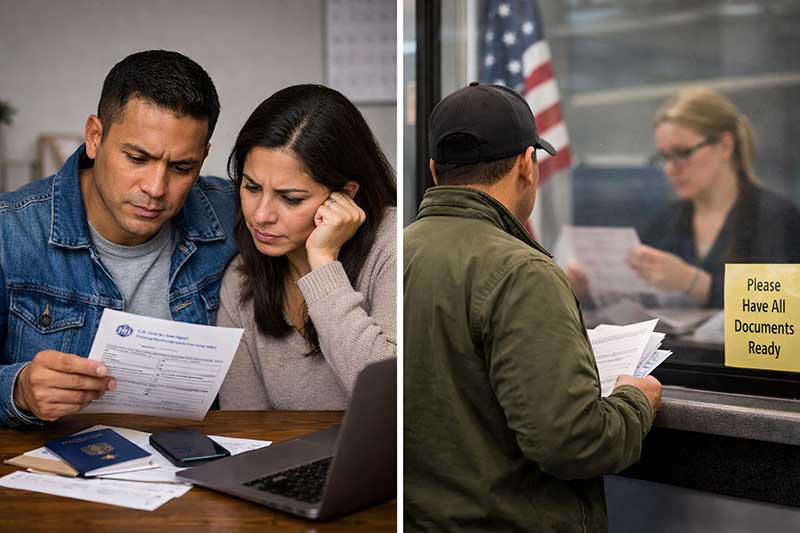
Adjustment of status inside the U.S.: when it may still be possible
One of the most common questions is whether someone who is unlawfully present can still get papers without leaving the country. In some cases, yes—especially when:
- The person entered lawfully (for example, with a visa), and
- There is a valid immigration basis, such as an immediate relative petition.
However, unlawful presence in the U.S. and your immigration history can limit or eliminate this option, depending on the facts of your case.
Can I get papers if I’m unlawfully present, without leaving the United States?
In some cases, yes. Sometimes adjustment of status inside the U.S. is possible if the entry was lawful and there is a strong basis (for example, certain immediate relatives). But if the entry was without inspection—or if there are other inadmissibility issues—the case may be pushed into consular processing, where leaving the U.S. can trigger bars. The answer depends on how you entered, your category, and your history.
That’s why, before starting anything, it’s important to understand how to get a Green Card based on your specific situation—not on someone else’s experience.
Consular processing abroad: the biggest risk
When adjustment of status inside the U.S. isn’t possible, the alternative is usually consular processing. This is where many cases become seriously complicated.
When you leave the U.S. for a consular interview:
- The 3- or 10-year unlawful presence bars may trigger automatically, if they apply.
- You may end up stuck outside the United States.
This is one of the riskiest scenarios tied to unlawful presence in the U.S., because one misstep can be very hard to undo.
Quick checklist before leaving the U.S. (if you have ever been out of status):
- Confirm whether you have already accrued unlawful presence and from what date.
- Review your I-94 and your type of entry (visa, ESTA, or entry without inspection).
- Verify whether leaving would trigger the 3- or 10-year bar.
- Do not schedule a consular interview without a strategy (possible waiver, evidence, and timing).
- If there were arrests, prior orders, or criminal history, don’t make decisions without legal advice.
Family petitions and priority dates
Having an approved family petition does not mean you can return quickly or fix your status without obstacles. Many cases get harder because key factors are not analyzed from the start. The essentials here include:
- Who the petitioner is.
- The immigration category under which the case is filed.
- The priority date, which determines how long you must wait before you can move forward.
Many people start cases without realizing their category involves years of waiting—and during that time, inadmissibility can still be a real barrier.
Situations where there may still be a solution
Despite everything above, being unlawfully present does not always mean all hope is lost. Depending on the case, there may still be options such as:
- Specific adjustments allowed by law;
- Immediate-relative family petitions; or
- Humanitarian relief.
The key is not to make rushed decisions—especially leaving the country without legal guidance.
Legal options if you have already accrued unlawful presence
Accruing unlawful presence does not always mean everything is lost. Depending on your facts, there may still be legal alternatives—but it’s critical to know what applies and what does not.
Immigration waivers: when they can help
If unlawful presence has created inadmissibility, a waiver may be the missing piece that allows the case to move forward. However, waivers do not apply to everyone, and the most common mistake is assuming you can file one without first identifying the inadmissibility ground and the qualifying relative.
Asylum, withholding, and other protections
In very specific situations, some people may explore protection-based options such as:
- Asylum in the USA;
- Withholding of removal; or
- Other humanitarian protections provided by law.
These options are not based on unlawful presence itself, but on the existence of serious risks if the person returns to their home country, such as persecution or severe harm. That said, not all cases qualify, and the legal standards are often strict.
Cancellation of removal
When someone faces a case in immigration court, it may be possible in some situations to evaluate cancellation of removal as a form of relief.
However, this relief:
- Is not easy to obtain;
- Requires meeting specific requirements; and
- Depends on the judge’s discretion.
Even so, for certain people, it can make the difference between remaining lawfully in the U.S. or receiving a removal order.
What to do if ICE gets involved
If there is contact with ICE or a risk of detention:
- Do not sign documents you do not understand; and
- Do not assume there is “no solution.”
In these situations, timing and legal strategy are critical.
Common mistakes that make unlawful presence consequences worse
Leaving the U.S. without legal advice

One of the most expensive mistakes (and one that most worsens unlawful presence in the U.S.) is leaving the United States when you shouldn’t. By doing so, many people automatically trigger the 3- or 10-year bars and end up stuck outside the country.
Reentering without permission or “trying your luck”
Trying to return without authorization—or using incorrect information—can radically worsen the situation because it may:
- Trigger the permanent bar.
- Lead to criminal charges.
- Close doors that were still open.
Lying to immigration or leaving out information
Fraud or misrepresentation in immigration matters is not easily fixed. A single lie can create an additional ground of inadmissibility.
Ignoring official notices or immigration appointments
Failing to respond to notices, ignoring appointments, or “letting time pass” can lead to:
- In-absentia removal orders.
- Lost opportunities to defend your case.
- Unexpected detention.
If a case is already pending, Los Angeles immigration court representation can be decisive in protecting your rights.
When it’s critical to speak with an immigration lawyer
Not every case requires immediate legal help, but there are situations where waiting—or assuming—can close important options.
Signs of immediate risk
You should seek legal advice as soon as possible if:
- You have accrued unlawful presence and plan to leave the U.S.
- You have an approved petition but don’t know whether you can adjust status.
- You’ve had contact with ICE or a prior detention.
- There is a criminal history, even if it’s old.
Cases where there may still be a path forward
Even if your situation looks complicated, there may still be forms of relief or legal strategies that change the outlook. The difference often comes down to details like your manner of entry, prior orders, criminal history, and which options can be pursued without making irreversible mistakes.
How to protect your immigration future
A lawyer doesn’t just analyze your past—they focus on how to protect your future:
- Which filings to avoid;
- Which steps may help; and
- When it’s better to wait before acting.
That strategic approach is often what makes the difference between losing an opportunity and preserving it.
Understand the risks and act strategically
Unlawful presence in the U.S. goes far beyond a simple warning. It can affect your ability to obtain a Green Card, return to the country, reunite with family, or even avoid removal.
Every case is different. What worked for someone else could be a serious mistake for you. That’s why, before leaving the country, attempting to reenter, or starting any process, it’s essential to get informed and act based on legal strategy—not assumptions.
If you need clear, realistic guidance, the immigration attorneys at Lluis Law can help you evaluate your situation and identify the best available option for you.
LATINOS WITH OVER 60 YEARS EXPERIENCE
Tell Us Your Case