


An R-1 visa lawyer in Los Angeles helps religious organizations hire temporary workers. The R-1 classification requires a qualified sponsor, two years of membership in the religious denomination, and at least 20 hours of religious work per week.
At Lluis Law, we review job duties, tax documentation, compensation, and potential issues with USCIS before filing Form I-129.
For more than 40 years, we have helped immigrants establish themselves in the United States and navigate their immigration cases. Every R-1 petition requires careful review of the position and sponsoring organization.
Latino attorneys with over 60 years of combined experience
Tell us about your case
Speak with our team about your options and next steps.
English & Spanish
How Can an R-1 Visa Lawyer Help a Religious Organization?
An R-1 petition must provide verifiable information about the employer, religious duties, work location, and means of financial support.
- Initial assessment: distinguish ministerial duties from primarily administrative tasks.
- Organizational evidence: verify tax exemptions, affiliations, and work locations.
- Worker evidence: document two years of denominational membership, credentials, and duties.
- Petition and follow-up: file Form I-129 and respond to any requests for evidence (RFEs).
- Continuity of religious work: prepare extensions, employer changes, and potential EB-4 options.
An R-1 visa lawyer at Lluis Law compares a letter appointing someone as a “pastor” or “missionary” with the person’s actual duties, training, and religious records. If administrative duties predominate, the issue should be addressed before filing Form I-129.
What Is an R-1 Visa for Religious Workers?
The R-1 visa is a nonimmigrant visa for individuals seeking to enter the United States temporarily to perform religious work.
Some benefits of the R-1 religious worker visa include:
- Traveling within and outside the United States.
- Remaining lawfully in the United States for an initial stay of up to 30 months, with extensions up to a total maximum of five years.
- Working legally in the United States in a religious capacity.
- Bringing qualifying family members (a spouse and unmarried children under age 21) to the United States.
Foreign religious workers are individuals duly authorized by a tax-exempt religious organization. Qualifying roles may include ministers, rabbis, priests, monks, and missionaries. Not every job with a religious organization qualifies.
Accompanying family members who obtain R-2 status may also live in the United States for the same authorized period as the R-1 principal. However, R-2 status does not authorize employment. They may study, but they cannot work based on R-2 status alone.

Who Qualifies for an R-1 Visa?
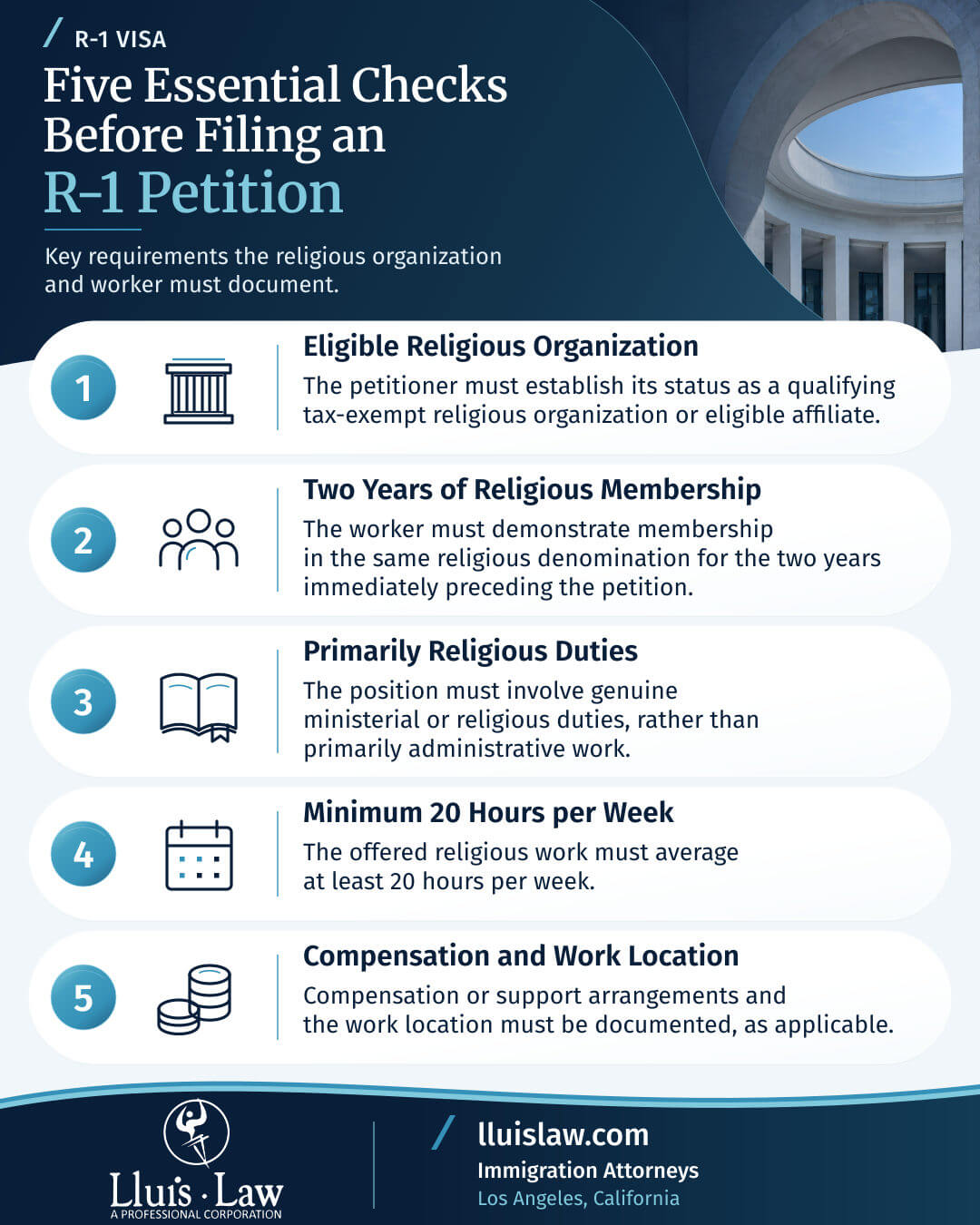
To qualify for an R-1 visa, both the religious worker and the sponsoring organization must meet the applicable requirements:
- Petitioning organization: a U.S. nonprofit religious organization, or an eligible affiliated organization, with the required tax-exempt status.
- Membership: two years of membership in the same religious denomination, though not necessarily the same congregation.
- Duties: a ministerial position or a genuine religious occupation or vocation for which the worker is qualified.
- Work schedule: an average of at least 20 hours per week performing the offered religious work.
- Compensation: salary or support backed by the organization’s financial records, subject to regulated exceptions for certain missionaries.
What Does USCIS Consider a Religious Denomination?
When determining whether a religious denomination exists, USCIS considers shared characteristics such as the following. Not every characteristic must be established:
- Shared beliefs.
- A common code of doctrine.
- A common form of worship.
- Places of worship or congregation.
What Does USCIS Consider a Religious Occupation?
A religious occupation is a position directly related to the beliefs and practices of a religious denomination. Working for a religious organization is not enough: the job itself must be primarily religious in nature.
Primarily administrative or support positions, such as security, maintenance, or fundraising roles, do not independently qualify as religious occupations. Some incidental duties may be part of a ministerial role, but a religious job title alone does not establish the nature of the work.

When assessing positions with mixed responsibilities, Lluis Law compares the job description with worship schedules, educational programs, and specific duties. The key question is the worker’s primary function, not simply where the work is performed.
How Do You Prove Two Years of Religious Affiliation?
Letters from religious leaders may help, but they should be consistent with existing membership records, certificates, appointments, activities, and other available documentation.
We review dates and any changes between communities or affiliated organizations before concluding that the required period has been met. The two years relate to the denomination, not necessarily a single place of worship.
How to Apply for an R-1 Visa Step by Step
To obtain an R-1 visa, a U.S. employer must file a petition on the worker’s behalf using Form I-129, Petition for a Nonimmigrant Worker, with U.S. Citizenship and Immigration Services (USCIS). Foreign workers cannot file this petition on their own behalf.
The employer must submit evidence of eligibility for the R-1 classification, particularly documentation demonstrating compliance with Volume 2, Part O, of the USCIS Policy Manual.
- 1. Evaluate the sponsor and position: verify the organization, job duties, and work schedule.
- 2. Prepare the petition package: gather supporting evidence, the R-1 supplement, and required certifications.
- 3. Address USCIS review: respond to any RFEs and prepare for possible inspections.
- 4. Determine the immigration process: assess consular processing with Form DS-160 or a change of status.
- 5. Review admission and compliance: follow the approved employment and authorized-stay conditions.
Approval of Form I-129 does not automatically guarantee issuance of an R-1 visa. The consulate decides whether to issue the visa, and CBP determines admissibility at the port of entry. The documentation must accurately reflect the actual duties.
Documents Required From the Worker and the Organization
| Sponsoring organization | Religious worker |
|---|---|
| Current IRS tax-exemption determination letter, or group exemption with proof of coverage; affiliation documents, if applicable. | Records establishing at least two years of membership in the religious denomination. |
| Job description, work location, schedule, budget, and evidence of salary or support. | Ordination, training, authorization, or religious experience records relevant to the position. |
| Form I-129 with the applicable supplement and certifications. | For consular processing: passport, DS-160 confirmation, fee receipt, and information required by the consulate. |
If the worker will receive housing and meals as support, it is not enough to say that the congregation “will take care of everything.” We review budgets, agreements, housing availability, and the source of funds. Missionaries who will not receive ordinary compensation must document an established program, rather than merely claiming that they will live on donations.
At the consular interview, applicants may be asked for original documents or additional evidence depending on their circumstances, such as a minister’s authorization and duties, qualifications for a religious vocation, or records establishing the relationship between affiliated organizations. The table above summarizes the principal supporting documents.
What Happens During a USCIS Inspection?
USCIS may inspect the organization before or after deciding the petition and visit the worksite to verify religious activities, working hours, financial support, and the sponsor’s actual operations. If USCIS conducts a preapproval inspection, passing that review is a condition of approval.
Effective preparation is not about rehearsing answers. It means ensuring that organizational representatives can locate authentic records and consistently explain who supervises the worker, what the schedule involves, and how the worker is paid or supported.
Inconsistencies between the petition and day-to-day activities may lead to additional questions or an RFE.
Some of the most practical details for the organization to verify include:
- The address where the religious worker will perform the job.
- The worker’s salary, responsibilities, and work schedule.
How Long Does an R-1 Petition Take, and How Much Does It Cost?
R-1 petition processing times depend first on USCIS and then, when applicable, on consular appointment availability. No fixed two- or three-month timeline applies to every case. Check the official USCIS processing time estimates and appointment availability at the relevant consulate.
Premium processing with Form I-907 may provide USCIS action within the applicable regulatory period of 15 business days once the requirements for starting that period have been met. It does not guarantee approval or eliminate inspections, RFEs, or consular wait times.
| Fee | Reference amount (USD) |
|---|---|
| Form I-129 filing, R-1 classification | $510, plus applicable additional fees. |
| Asylum Program Fee, qualifying nonprofit organization | $0; qualifying status must be documented. |
| Optional Form I-907 premium processing | Additional $1,780 effective March 1, 2026. |
| Consular R visa application | $205 per applicant, excluding any applicable reciprocity fees. |
These are separate fees: the organization pays the petition-related fees, while the consular applicant pays the visa application fee when applicable. Before filing, we check the current USCIS fee schedule and Department of State visa fees, because an incorrect payment can lead to rejection or delays.
How Long Can You Stay in R-1 Status?
The initial authorized period of stay in R-1 status may be up to 30 months. The worker may request an extension of up to another 30 months, subject to the applicable five-year limit.
The validity period of a consular visa may differ from the authorized period of stay. Check the expiration date on your Form I-94.
What Changed About the Five-Year R-1 Limit in 2026?
2026 regulatory change: As of January 16, 2026, R-1 workers who reach the five-year limit are no longer required to spend a full year outside the United States. However, to return in R-1 status after reaching that limit, the worker must depart and have a new approved Form I-129 petition and, when applicable, a new visa. The change does not permit indefinite extensions of a single period of stay. See the current federal rule.
What Do We Review Before Filing a New Petition for Reentry?
Before a new petition is filed, Lluis Law reviews periods of physical presence, Form I-94 history, and departures from the United States. We also assess potential consular delays that could affect the worker’s return even though the former one-year waiting period no longer applies.
Can You Change Employers or Work Locations With an R-1 Visa?
R-1 religious workers may change employers or work locations if they meet the applicable requirements. However, a new sponsor must file its own Form I-129 and obtain approval before the worker begins that employment.
An R-1 visa lawyer can assess whether a change requires a new or amended petition. The organization must notify USCIS of employment termination within 14 days. Avoid making material changes in work location without first reviewing the petition.
At Lluis Law, we verify the sponsor’s identity and approved work locations. Two congregations in the same denomination are not necessarily the same employer.
- If the legal employer changes, a petition from the new sponsor is generally required.
- If the position or work location changes materially, an amended petition may be necessary.
- A transfer within the same denomination does not, by itself, guarantee continued work authorization.
Frequently Asked Questions About R-1 Visas
Key answers about R-2 status, EB-4, interviews, and denials.

Can an R-1 Visa Lead to a Green Card?
Some religious workers may have a path to permanent residence through the EB-4 category and Form I-360, with assistance from an EB-4 visa lawyer. However, permanent residence is not automatic and is not granted simply because someone held R-1 status.
The requirements for prior religious employment, working hours, and visa availability differ. If the requirements are met and a visa is available, the worker may then consider adjustment of status or consular processing.
For religious workers who are not ministers, the statutory authorization for the religious EB-4 subcategory is temporary and requires ongoing monitoring. That is why we distinguish the R-1 employment plan from a potential permanent residence strategy, including the timeline for each process.
Can an R-2 Spouse Work in the United States?
No. A spouse and unmarried children under age 21 may accompany an R-1 worker in R-2 status, but that classification alone does not authorize employment. Family members who need to work must assess whether they qualify for separate employment authorization based on their immigration circumstances.
What Happens if USCIS Issues an RFE or Denies the Petition?
An RFE identifies evidence that USCIS considers insufficient; it is not a denial. It is important to determine what USCIS is questioning: tax-exempt status, two years of denominational membership, the religious occupation, financial support, or consistency of the position.
A USCIS petition denial and a consular visa refusal require different legal responses, depending on the grounds and available review options.
False or contradictory documentation can have serious consequences. Missing records should never be replaced with letters containing fabricated dates. A complete explanation supported by evidence is generally preferable to documents that cannot withstand verification.
Do I Need a Consular Interview if Form I-129 Has Already Been Approved?
If you are outside the United States and need an R-1 visa, you will generally need to complete consular processing, submit Form DS-160, and attend an interview unless a current rule provides an exception.
USCIS approves the petition, but the consulate decides whether to issue the visa, and CBP decides whether to admit the worker. Canadian and Bermudian citizens may be exempt from the visa requirement, although they still need an approved petition to request admission in R-1 status.
If an interview is required, schedule it according to the consulate’s instructions and available appointments. Bring your confirmation, requested documents, and a consistent explanation of your religious duties.
Speak With an R-1 Visa Lawyer in Los Angeles
If your congregation needs to hire a minister, missionary, or other religious worker, the immigration lawyers in Los Angeles at Lluis Law can assess the organization, the position, and the candidate’s background. We identify missing evidence and the best next step before an incomplete petition puts the case at risk.
Contact us to discuss an initial petition, extension, change of employer, or issue with USCIS. An individualized assessment can help determine whether the R-1 classification is appropriate and how to prepare a petition supported by verifiable evidence.
Latino attorneys with over 60 years of combined experience
Tell us about your case
Speak with our team about your options and next steps.
English & Spanish