

A student visa lawyer can help you apply for an F-1 or M-1 visa, prepare for your interview, or address student status issues. David A. Lluis and Ramiro J. Lluis handle these matters from Los Angeles.
Admission to a school does not guarantee a visa. If you already have an I-20, an upcoming interview, or a previous denial, our immigration lawyers in Los Angeles can review your I-20, DS-160, and financial evidence before you take the next step.
Latino attorneys with over 60 years of combined experience
Tell us about your case
Speak with our team about your options and next steps.
English & Spanish
How Can a Student Visa Lawyer in Los Angeles Help You?
The legal guidance you need depends on whether you are applying for a visa at a consulate for the first time, requesting a change of status within the United States, or already enrolled in school and concerned about losing your immigration status.
- Before applying: Verify the school and the appropriate F-1 or M-1 classification, check the I-20 start date, and identify inconsistencies involving your studies, funding, or immigration history.
- When preparing your application: Review the DS-160 and financial documents, and prepare clear answers about your studies, sponsor, and plans after completing the program.
- After a visa denial: Determine whether the refusal was based on Section 214(b), Section 221(g), or another ground, then decide whether to correct the evidence, respond to a request for additional information, or consider another option.
- If you are already studying in the U.S.: Work with your school to review program changes, travel, authorized employment, OPT/CPT deadlines, or possible reinstatement of status.
The starting point is not gathering as many documents as possible. It is identifying what immigration officials need to verify. If a family member is paying for your studies, showing a bank balance alone may not be enough. You should be able to explain who is paying, how much the program costs according to the I-20, and whether the funds are available.
Requirements for an F-1 or M-1 Student Visa
If you want to study in the United States, you will generally need an F or M visa. The appropriate category depends on whether you plan to enroll in an academic or vocational program.

The main requirements include:
- Be accepted by an SEVP-approved school. The school will register you in the SEVIS system and issue Form I-20, which you need to apply for the visa.
- Pay the SEVIS I-901 fee.
- Complete Form DS-160 and upload your photograph.
- Pay the visa application fee.
- Schedule and attend an interview at the appropriate U.S. embassy or consulate under the applicable consular rules.
- Present the required documents at your interview.
- Meet the school’s language proficiency requirements, if applicable.
- Have a valid passport that meets the requirements applicable to your nationality.
- Provide evidence of sufficient financial resources for tuition and living expenses.
You must also demonstrate that you intend to pursue genuine studies and comply with the conditions of a temporary stay. University admission alone does not replace the consulate’s assessment of your nonimmigrant intent.
What Documents Do I Need to Apply for a Student Visa?
Documents you may be asked to provide include:
- A valid passport (meeting the validity requirements for your case).
- Your DS-160 confirmation page.
- A fee payment receipt, if required by the consulate.
- A signed Form I-20.
- A printed photograph, if requested by the embassy or consulate.
- Records of previous education (transcripts, diplomas, etc.).
- Proof of financial resources.
- Evidence of your intention to return to your home country after completing your studies, when relevant to your circumstances.
For applications funded by a third party, the sponsorship letter, verifiable account statements or balances, and costs reported by the school should tell a consistent story. For example, a recent large bank deposit may require documents explaining where the money came from. An apparently sufficient balance does not answer every question.
Important: You cannot use a B-2 tourist visa or ESTA authorization to enroll in a formal academic program. Limited exceptions exist for short, recreational courses that do not award academic credit, but these are not equivalent to a student visa.
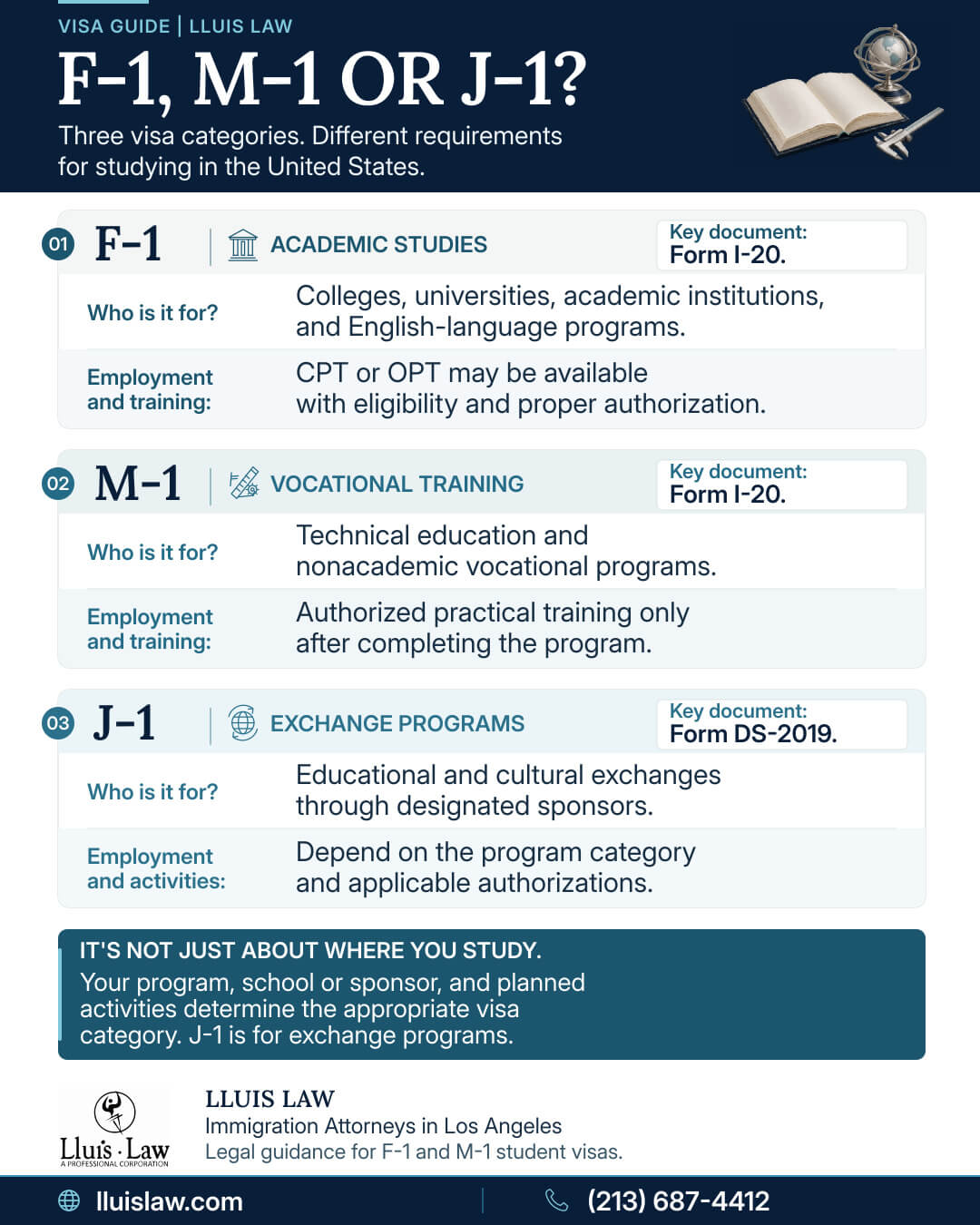
Which Visa Do You Need: F-1, M-1, or J-1?
The United States has several visa categories for students, all classified as nonimmigrant visas. The correct classification depends on the program, not the applicant’s preference.
| Visa | Type of Study | Primary Document |
|---|---|---|
| F-1 | College, high school, academic programs, or approved language schools | I-20 from an SEVP-certified school |
| M-1 | Nonacademic technical or vocational training (excluding language programs) | I-20 from an SEVP-certified school |
| J-1 | Educational or cultural exchange through a sponsored program | DS-2019 from an authorized sponsor |
F-2 and M-2 visas are derivative categories for certain family members. J-1 visas have separate rules. If you are considering an exchange program, speak with a J-1 visa lawyer before choosing a category. To compare other options, see the different types of U.S. visas.
A technical course does not become an academic program simply because it is called a “certification,” and not every student exchange qualifies for an F-1 visa. We review the program’s actual purpose, the authorized institution, and the document issued before identifying the appropriate path.
How Much Does a Student Visa Cost in the United States?
For a standard F-1 or M-1 consular application, the two usual federal fees total $535 USD, based on the official reference amounts:
| Fee | Usual Amount |
|---|---|
| SEVIS I-901 fee (F/M) | $350 |
| Nonimmigrant visa application fee (MRV) | $185 |
| Total for both fees | $535 |
This total does not include tuition, housing, translations, attorney fees, or possible reciprocity fees. Federal law also provides for a visa integrity fee. Its implementation and collection procedures should be checked against current instructions rather than automatically adding it to the total above. Always verify the official consular visa fees before paying.
There is no universal bank balance of $18,000 or $24,000 that guarantees approval. The amount you must document depends on the I-20, program length, scholarships, living expenses, and who will cover the costs. Your financial evidence should support those figures with verifiable records, not a generic minimum.
How to Apply for a Student Visa Step by Step
In general, to begin studying in the United States, you must:
- Choose an educational program and make sure the institution is SEVP-certified. You can verify its status using the official school search tool.
- Confirm your admission and receive Form I-20. Check your name, program, dates, and estimated expenses.
- Pay the I-901 fee through the official SEVIS fee payment website and keep your receipt.
- Complete the DS-160 consistently with your I-20 and immigration history.
- Pay the consular fee, schedule your appointment, and prepare your academic and financial evidence.
- Attend your interview and answer questions accurately. If additional documentation is requested, follow the consulate’s instructions.
The school issues the I-20 but does not approve the visa. That decision belongs to the consular officer. Submitting accurate documentation may help prevent avoidable mistakes, but it cannot guarantee approval.
What Questions Are Asked During a Student Visa Interview?
During the interview, the consular officer will assess whether you meet the student visa requirements, focusing on whether you are a genuine student, have sufficient financial resources, and have a credible temporary purpose for your stay.
You may be asked questions such as:
- Why did you choose this university?
- How will you pay for your education?
- Do you have family members in the United States?
- Do you plan to work while studying?
- What are your plans after graduation?
Our attorneys can check your answers against your I-20, academic background, and financial records. A brief, truthful explanation is generally more useful than a memorized speech. If you have a previous visa denial or family in the United States, that context should be addressed, not concealed.

How Long Does Processing Take, and When Can You Travel?
Visa processing can take weeks or several months, depending on interview availability, the country, your documents, and any additional checks. There is no universal 60-day deadline after approval that applies to every F-1 visa.
An F or M visa for a new student may be issued up to 365 days before the program starts, but initial entry into the United States generally cannot occur more than 30 days before that start date. Check the State Department’s published visa wait times and avoid purchasing nonrefundable travel based on an estimated date.
When you arrive at the airport or port of entry, you should:
- Carry your Form I-20, passport, and valid visa with you.
- Present your documents to the Customs and Border Protection (CBP) officer.
- Consider making two copies of your documents: one to leave in your home country and another for your school.
- Keep your original documents in a safe place throughout your stay.
After arriving in the United States, you must report to your school before the program start date listed on your Form I-20.
What Happens if My F-1 or M-1 Visa Is Denied?
The appropriate response depends on the reason for the refusal. A denial under Section 214(b) calls for a different approach than one under Section 221(g):
| Ground | What It Means | Reasonable Next Step |
|---|---|---|
| INA 214(b) | The applicant did not sufficiently establish eligibility or temporary intent | Review what material change in circumstances or new evidence could support another application; there is no ordinary consular appeal from this refusal |
| INA 221(g) | Documents, information, or administrative checks remain outstanding | Respond precisely to the consulate’s request or follow the stated processing instructions rather than automatically submitting a new DS-160 |
| Other grounds | An inadmissibility ground or another legal restriction may apply | Review the legal provision involved and whether a legal option exists before paying another fee |
A student visa lawyer can review the ground for refusal before recommending another application. Without material changes, attending another interview alone is unlikely to overcome a 214(b) denial.
For a 221(g) refusal, the better approach is to determine exactly what documents or additional review the consulate requires and respond according to its instructions.
Lluis Law can review your refusal notice, prior application history, and case records before recommending the next step. See the official explanation of visa denials.
Can You Change From Tourist to Student Status in the United States?
A student visa lawyer can evaluate the consular option alongside your immigration history. In certain circumstances, someone already in the United States in another nonimmigrant status may request a change to F-1 or M-1 status using Form I-539. This is not the same as obtaining a new visa at a consulate, and not every visitor is eligible.
Before filing a change of status application, we examine four issues:
- The class of admission shown on your I-94 and the expiration of your authorized stay.
- Whether the I-20 dates are compatible with USCIS’s actual decision timeline.
- Whether you previously studied, worked, or engaged in other activities inconsistent with visitor status.
- Whether consular processing offers a viable alternative to filing from within the country.
Someone admitted in B-1/B-2 visitor status must not begin formal studies while waiting for a change to F-1/M-1 status. If classes begin before a decision is issued, you may need to coordinate new start dates. Inconsistent statements about your plans when entering the country also warrant review. See the legal implications of seeking a Green Card after entering on a tourist visa.
How to Maintain Your Status While Studying in the U.S.
The visa stamp in your passport and your immigration status within the United States are not the same thing. An F-1 student may remain in an authorized period of stay even after the visa stamp expires, provided the applicable conditions are met. Likewise, a valid visa does not, by itself, restore status that has been lost.
- Enroll full time unless a reduced course load is authorized by your designated school official (DSO) when permitted under the rules.
- Keep your I-20 current and report changes of address, program, funding, or school as required.
- Do not work outside the scope of your employment authorization.
- Seek guidance before taking a break from classes, traveling, or transferring. Changing schools or dealing with a terminated SEVIS record requires reviewing the proper procedure.
If you stopped attending classes or worked without authorization, a one-size-fits-all “fix” is not appropriate. It is important to distinguish between an administrative SEVIS correction, possible reinstatement through USCIS, and a new admission after leaving the country. The right approach depends on the reason, the dates, and what your school record shows.

How Long Can You Stay, and What Happens After Graduation?
The length of your stay depends on your visa classification, I-94, and compliance with the rules. For many F-1 students admitted for duration of status (D/S), the authorized period of stay is tied to their program and approved practical training.
| Situation | Usual Rule |
|---|---|
| F-1 after completing a program or authorized practical training | 60-day grace period |
| M-1 after completing a program or authorized practical training | 30-day grace period |
| Continuing to work without authorization | Not permitted during the grace period |
Some F-1 graduates may qualify for OPT and later consult an H-1B visa lawyer if they receive a job offer that could meet the applicable requirements.
An F-1 visa does not automatically provide a Green Card. If an employment-based or family-based permanent residence option becomes available, a Green Card lawyer can assess whether there is an independent basis for eligibility and whether adjustment of status through USCIS may be appropriate.
Note: Rules governing duration of status and authorized student stays may change following administrative or court decisions. Before seeking an extension, transferring schools, or traveling, verify the applicable rules, your I-94, and your DSO’s guidance.
Can You Work on an F-1 or M-1 Visa?
F-1 students may work in the United States, but restrictions apply. During the academic term, certain on-campus jobs are permitted for up to 20 hours per week. Off-campus employment requires the appropriate authorization.
| Option | Practical Rule |
|---|---|
| F-1 on-campus work | Employment is permitted subject to regulatory requirements and hour limits |
| CPT (F-1) | Curricular practical training that the DSO must authorize on the I-20 before it begins |
| OPT (F-1) | Practical training related to the field of study; requires USCIS authorization and generally an EAD before working |
| STEM OPT | A possible 24-month extension for qualifying graduates and eligible employers |
| M-1 | Does not have the same CPT/OPT options as F-1; permitted practical training is limited and requires authorization |
Do not confuse your school’s OPT recommendation with an approved work permit. Likewise, do not assume that unpaid internships are exempt from immigration rules. Review the official USCIS student employment rules before beginning any activity.
Frequently Asked Questions About Student Visa Lawyers
Do I Need a Student Visa Lawyer to Apply for an F-1 Visa?
No. You can apply on your own, but legal guidance can be especially valuable if you have a previous denial, are changing status within the United States, rely on a financial sponsor, or have questions about employment, past studies, or inadmissibility.
Can My Spouse and Children Study With Me?
Eligible spouses and unmarried children under age 21 may apply for F-2 or M-2 visas. Each needs an individual I-20, but they generally do not pay a separate SEVIS I-901 fee. Their study and employment options have their own restrictions, so each family member’s application should be reviewed before traveling.
What About Social Media Screening and Nationality-Based Restrictions?
The State Department provides for online presence screening of F, M, and J visa applicants and has published instructions regarding the visibility of their social media accounts. Visa issuance restrictions also apply to certain nationalities, with different exceptions and scopes. Before paying a fee or setting a travel date, check the current consular guidance for your nationality.
Can I Take a Break From My Studies in the U.S. on a Student Visa?
In certain circumstances, a student may temporarily interrupt their studies, but must still comply with the conditions of their status. Academic leave does not always preserve immigration status. Speak with your DSO before you stop attending classes, and seek legal advice if your enrollment has already been interrupted or your SEVIS record shows as terminated.
Student Visa Lawyers in Los Angeles: How Lluis Law Can Help
David A. Lluis and Ramiro J. Lluis bring decades of legal experience in immigration matters from Los Angeles. For a student visa application, three elements must align: the program listed on the I-20, the information provided on the DS-160, and the supporting financial and immigration evidence.
- Initial application: Review the school, funding, and interview preparation before submitting your case.
- Denial or delay: Identify the legal ground and prepare a fact-supported next step.
- Status problem: Examine SEVIS records, dates, and employment authorization before deciding how to proceed.
Contact a student visa lawyer at Lluis Law to evaluate your F-1 or M-1 application, a previous denial, or a problem that arises during your studies. Immigration authorities make the final decision. Our role is to help you prepare a clear, legally sound case.
Latino attorneys with over 60 years of combined experience
Tell us about your case
Speak with our team about your options and next steps.
English & Spanish