


A T visa lawyer at Lluis Law can help survivors of sex trafficking and forced labor in Los Angeles explore their immigration protection options. We review the facts, available evidence, and potential risks before preparing an application for USCIS.
At Lluis Law, our attorneys have 60 years of combined legal experience. We handle cases from Los Angeles and can advise people elsewhere in the United States about this federal immigration benefit. You do not need to have all your evidence organized before discussing your options with us.
Latino attorneys with over 60 years of combined experience
Tell us about your case
Speak with our team about your options and next steps.
English & Spanish
How a T Visa Lawyer in Los Angeles Can Help You
A T visa case involves much more than filling out forms. We first determine whether the circumstances meet the federal definition of a severe form of trafficking in persons. We then document the connection between the trafficking and the applicant’s presence in the United States, any required contact with law enforcement, and the hardship that removal would cause.
- Identifying trafficking: we distinguish labor exploitation from the use of force, fraud, or coercion to compel labor or services.
- Protection and confidentiality: we assess risks to the survivor and their family, review USCIS correspondence, and discuss how to preserve evidence safely.
- Immigration and criminal defense strategy: we evaluate unlawful entries, criminal records, removal orders, related charges, and potential waivers before taking action.
- Filing and follow-up: we organize the personal statement, supporting records, Form I-914 and related forms, and responses to any USCIS requests.
David and Ramiro’s experience as criminal defense lawyers in Los Angeles is particularly valuable when a survivor’s account involves threats, incidents investigated by law enforcement, or potential criminal consequences.
The practical question is not only what happened. It is also what can be established, which details need to be verified, and which steps require legal advice to avoid harming another proceeding.
What Is a T Visa and Who Does It Protect?
A T visa provides nonimmigrant status to certain people who are or have been victims of severe forms of trafficking in persons. It can provide immigration protection, employment authorization, and, if additional requirements are met, a path to lawful permanent residence.
Congress established this visa in 2000 under the Victims of Trafficking and Violence Protection Act. The law covers sex trafficking and labor trafficking, even when the exploitation did not involve crossing an international border.
Sex Trafficking and Forced Labor: How to Recognize Them
Federal law recognizes two categories of severe forms of human trafficking:
- Sex trafficking: recruiting, harboring, transporting, or obtaining a person for a commercial sex act through force, fraud, or coercion. When the person is under 18, those means do not need to be proven for commercial sex trafficking.
- Labor trafficking: recruiting, harboring, transporting, or obtaining a person through force, fraud, or coercion for the purpose of subjecting them to involuntary servitude, peonage, debt bondage, or slavery.
Warning signs may include confiscation of a passport, threats to report someone to immigration authorities, surveillance, isolation, imposed debts, or restrictions on leaving a job. Trafficking can also occur in private homes, restaurants, agriculture, construction, and cleaning services.
However, workplace abuse does not automatically constitute trafficking. The legal assessment must show how coercion was used to obtain labor or services. This distinction helps prevent a potential employment claim from being confused with the requirements for a T visa.

Can Exploitation by a Smuggler, Employer, or Family Member Qualify for a T Visa?
Yes, depending on the facts. Labor trafficking may be involved if a smuggler uses threats to force someone to work off a debt, an employer withholds documents to prevent a worker from leaving, or someone compels domestic services through coercive control.
There is no universal minimum period of exploitation. Physical violence or confinement is not always necessary either. What matters is establishing the acts, means, and purposes defined by law. An unlawful border crossing or a debt alone is not enough.
If you also face charges related to how you entered the country, it is important to understand your rights when facing illegal entry charges and assess the trafficking claim separately from the criminal case.
Requirements for Applying for a T Visa in the United States
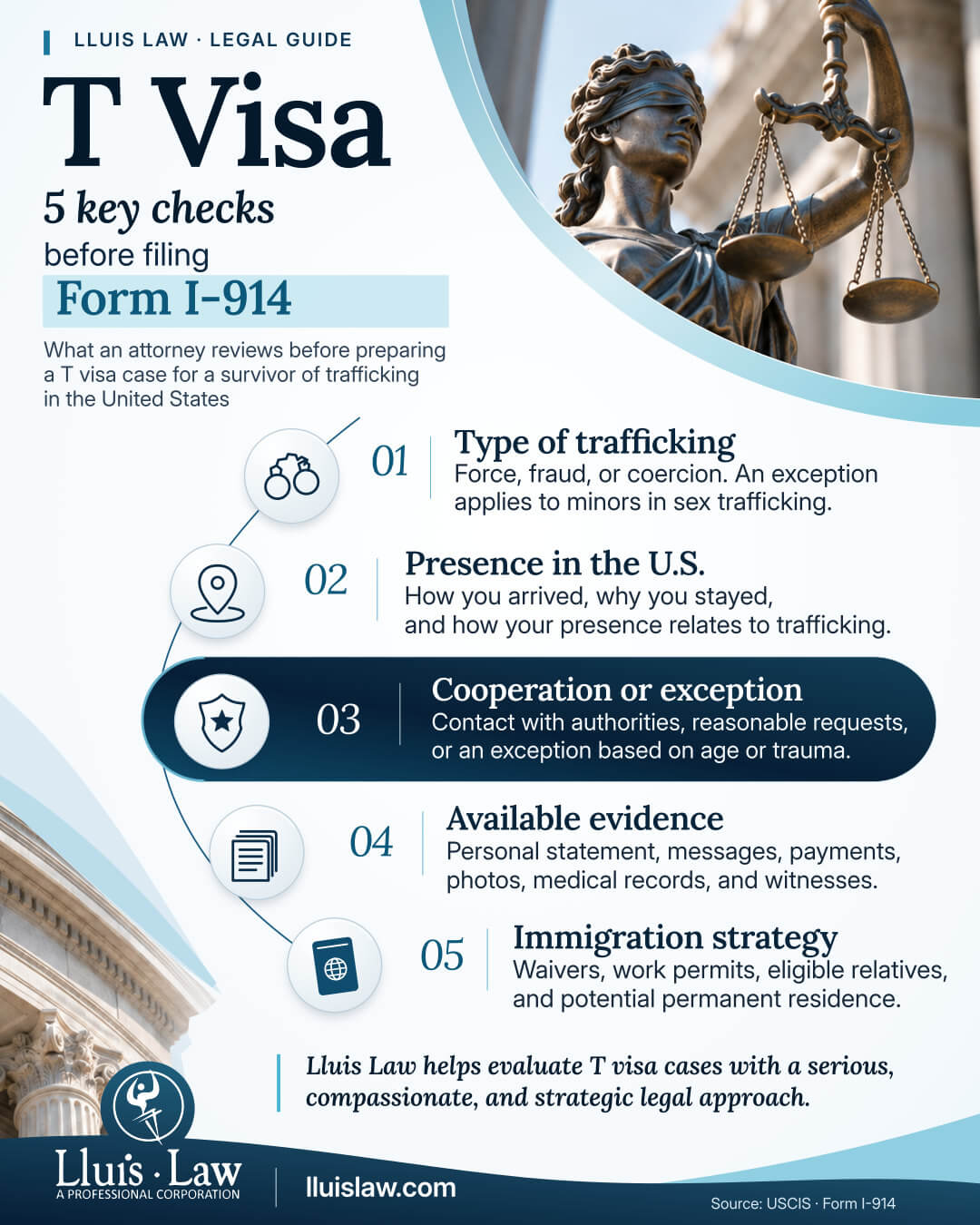
Eligibility must be assessed individually. As a general rule, USCIS requires applicants to establish the following elements:
- Victimization: having been subjected to a severe form of sex or labor trafficking under the federal definition.
- Physical presence: being in the United States, American Samoa, the Northern Mariana Islands, or at a port of entry on account of the trafficking. Simply living here without establishing that connection is not enough.
- Reasonable cooperation: complying with reasonable requests for assistance from an appropriate law enforcement agency, unless an age-based exemption or trauma-based exception applies.
- Extreme hardship: showing that removal would cause unusual and severe harm, considering risks of retaliation, medical needs, further victimization, and personal circumstances.
- Admissibility: being admissible or qualifying to request a waiver of certain grounds of inadmissibility.
The extreme hardship analysis is different from a general fear of returning to one’s home country. A useful statement connects the trafficking experience to specific risks, medical or psychological consequences, available support networks, and realistic prospects for protection.
Is a Police Report or Form I-914, Supplement B Required?
A police report is not mandatory. Form I-914, Supplement B is not required either. However, the general rule requires at least some contact with an appropriate law enforcement agency to report the trafficking and compliance with reasonable requests for assistance, even if no investigation is opened or criminal charges are filed.
That contact may occur by phone, electronically, or through other means. An exemption applies to individuals who were under 18 when at least one trafficking act occurred. An exception may also apply when physical or psychological trauma prevents cooperation. In these circumstances, even the initial contact may not be required.
Safety and Appropriate Contact With Law Enforcement
Our T visa lawyers in Los Angeles also assess whether a previous report was actually made to an appropriate agency, rather than assuming that a wage complaint qualifies as a trafficking report.
In sensitive cases, we first review which agency to contact, how the contact was documented, any threats received, and whether an exception may apply. Do not make statements without preparation and a careful assessment of risks to your safety and any related immigration or criminal proceedings.
- Contact: identify which agency has authority to investigate the trafficking.
- Documentation: safely preserve proof of the report or communication.
- Exception: assess the survivor’s age at the time of trafficking and any trauma that prevents cooperation.
Legal authority: 8 CFR § 214.208.
What Evidence Can Support a T Visa Application?
USCIS accepts any relevant credible evidence. A signed personal statement is a key component. Supporting evidence helps explain the circumstances and establish each requirement, even when official reports are unavailable.
| What must be established | Potentially useful evidence |
|---|---|
| Force, fraud, or coercion | Messages, contracts, lawfully obtained audio recordings, payment records, instructions, photographs, and witness accounts. |
| Presence on account of trafficking | Entry or residence records and a timeline of recruitment, transportation, escape, and continued presence. |
| Law enforcement contact or exception | Records of communication with an appropriate agency, optional Supplement B, or proof of age or trauma. |
| Harm if removed | Medical or psychological reports, current threats, risks of retaliation, and documentation about the country of return. |
| Admissibility and family | Immigration and criminal history, court decisions, civil records, and proof of family relationships. |
How We Evaluate a Personal Statement When Documents Are Missing
When documents are missing, the quality of the personal statement matters more than the quantity of paperwork. We organize the account without adding speculation or asking survivors to repeat their experiences unnecessarily.
- Timeline: we reconstruct who recruited the person, what was promised, when threats began, what work was imposed, and why the person could not leave freely.
- Indirect evidence: we compare messages and witness accounts against each legal requirement and identify what cannot yet be established without inventing details.
- Safety: we check that statements, translations, and sensitive reports do not disclose addresses, identities, or locations that could put someone at risk.
How to Apply for a T Visa With Lluis Law
The main application is filed with USCIS using Form I-914. We organize the process into five stages:
- Initial assessment: we identify the type of trafficking, when it occurred, immediate risks, and current immigration status.
- Evidence strategy: we prepare the personal statement, supporting documents, and explanations of physical presence, cooperation or an applicable exception, and extreme hardship.
- Additional forms: we assess Form I-914, Supplement A for family members, Supplement B when available, and Form I-192 if a waivable ground of inadmissibility applies.
- Filing and protection: we check current form editions, filing instructions, a safe mailing address, and whether employment authorization should be requested.
- Follow-up: we address requests for evidence, notices, changes in circumstances, and plans for future family or permanent residence applications.
You can also review our guide to waivers of inadmissibility to understand why each ground requires an individual legal assessment.
An I-192 waiver is not granted automatically. When a criminal history is involved, we distinguish among an arrest, a charge, and a conviction because each can have different immigration consequences.
Before filing, our T visa lawyers review entry documents, criminal case records, and previous statements to identify any potential ground of inadmissibility and determine whether a waiver may be available.
What Happens While a T Visa Application Is Pending?
Filing Form I-914 does not automatically stop removal or grant employment authorization. During the waiting period, it is important to distinguish among three situations:
- Pending application: USCIS may review whether the applicant qualifies for a bona fide determination.
- Favorable determination: under the regulations, enforcement of a final removal order is administratively stayed. Deferred action requires a separate decision.
- Work permit: employment authorization must be requested on Form I-765 under category (c)(40). USCIS recommends submitting it with Form I-914, but approval is not automatic.
Removal Orders and Ongoing Proceedings
If you have a final removal order, a pending hearing, or are in immigration detention, your case requires individualized attention. Our deportation lawyers can evaluate other defense options without assuming that filing Form I-914 alone will prevent removal.
If immigration court proceedings are already underway, it is also important to assess your options for immigration court representation in Los Angeles and the precise status of your case.
Legal authority: 8 CFR § 214.205 and 8 CFR § 214.204.
Benefits of an Approved T Visa
People who receive T nonimmigrant status may qualify for the following benefits:
- Remain in the United States for an initial period of up to four years, with possible extensions under circumstances established by law.
- Receive employment authorization associated with T-1 status. Derivative family members may need to submit Form I-765.
- Have an opportunity to apply for adjustment of status and obtain a Green Card once the legal requirements are satisfied.
- Seek derivative protection for certain family members based on age, family relationship, and, in some circumstances, the risk of retaliation.
- Access certain federal or state assistance programs and services for trafficking survivors when eligible under the rules governing those programs.

T Visas for Spouses, Children, and Other Family Members
Qualifying relatives seeking derivative T nonimmigrant status must complete Form I-914, Supplement A. The principal applicant’s age and family relationships determine the usual categories:
- T-2: the principal applicant’s spouse.
- T-3: unmarried children under 21, subject to applicable age-related rules and protections.
- T-4: parents of a principal applicant under 21, or qualifying parents under certain retaliation-related provisions.
- T-5: unmarried siblings under 18 in circumstances provided for by law.
- T-6: certain children of derivative family members who face a present danger of retaliation.
If the principal applicant is 21 or older, they can generally apply for an eligible spouse and children. If the principal applicant is under 21, parents and unmarried siblings under 18 may also qualify. The regulations provide exceptions for retaliation risks and protections when certain age thresholds are reached during processing.
Family members abroad may need to complete consular processing. Our family immigration lawyers can review each relative’s relationship and documents while keeping this process distinct from an ordinary family-based immigration petition.
T Visa vs. U Visa vs. VAWA: Which Protection Applies?
These options may involve overlapping circumstances of abuse or violence, but they are not interchangeable. The appropriate option depends on who caused the harm, the crime involved, the available evidence, and each program’s legal requirements.
| Immigration option | Who may qualify | Key distinction |
|---|---|---|
| T visa | Victims of severe forms of sex or labor trafficking. | Requires a connection between physical presence and trafficking. Supplement B is optional, but law enforcement contact or an applicable exception is generally required. |
| U visa: victims of qualifying crimes | Victims of certain crimes who suffered substantial physical or mental abuse. | Requires law enforcement certification on Form I-918, Supplement B, along with the other legal requirements. |
| VAWA: self-petition based on family abuse | Certain abused spouses, children, or parents of qualifying U.S. citizen or lawful permanent resident relatives. | Eligibility depends on the family relationship and battery or extreme cruelty. The abuser’s cooperation is not required. |
If a forced labor survivor was also assaulted, our U visa lawyers can assess whether the facts support that form of protection and what certification would be necessary.
When the abuse involves a relative who meets the legal criteria, our VAWA lawyers can evaluate a self-petition that does not depend on the abuser. Trafficking, qualifying crimes, and family relationships must be assessed separately before choosing an immigration option.
How Much Does It Cost to Apply for a T Visa?
The official filing fee for Form I-914 and its Supplements A and B is $0. Form I-192 filed in connection with a T petition, including for eligible derivatives, also has a $0 filing fee.
The Form I-485 application for adjustment of status as a T nonimmigrant is exempt from the filing fee under the applicable category. Professional fees and documentation expenses are separate.
Attorney fees, translations, and professional reports vary by case. Check current amounts and any additional charges in the official Form G-1055 fee schedule before filing any form.
How to Apply for a Green Card After a T Visa
To pursue lawful permanent residence after receiving T nonimmigrant status, a person files Form I-485 once the requirements for this category are met.
Generally, the applicant must have been continuously physically present for three years while in T status, or for the duration of the trafficking investigation or prosecution if that period ends sooner.
USCIS also reviews other elements, including good moral character, maintenance of status, and requirements concerning cooperation or extreme hardship. Admissibility and potential waivers must be examined at this stage as well. Initial T visa approval does not automatically grant a Green Card.
- Timing: review the years of physical presence in T status or the conclusion of the trafficking investigation.
- Eligibility: confirm good moral character, cooperation or an applicable exception, and admissibility.
- Evidence: gather records establishing physical presence, safety concerns, and the remaining requirements.
Planning begins with the initial application. Preserving evidence of physical presence, family records, immigration history, and decisions about any travel may help prevent problems later.
Can You Travel Outside the United States With a T Visa?
Traveling without first reviewing your documents, case status, and reentry options could affect your immigration protection and future eligibility for permanent residence. Approval of T status inside the United States does not automatically mean you have a consular visa that allows you to reenter.
If you are considering international travel, discuss absences, potential grounds of inadmissibility, and return requirements with an attorney. We explain these risks in our guide to traveling with a T visa.
Protection, Confidentiality, and Survivor Assistance in Los Angeles
Federal law restricts the disclosure of information connected to T visa applications. Those protections do not replace safety planning. It is important to evaluate mailing addresses, shared devices, third-party access to documents, and potential retaliation.
At Lluis Law, our immigration lawyers in Los Angeles consider how clients can receive notices without putting themselves at risk or revealing their location to others.
Local Coordination and Resources for Urgent Situations
Cases arising in Los Angeles may involve work in private homes, retail, restaurants, construction, or other industries. Documenting these cases requires identifying which local, state, or federal agency has the proper authority. Not every employment complaint automatically qualifies as a valid trafficking report.
It may also help to understand how to protect your rights as an immigrant worker and how to respond to ICE. If a removal order exists, we verify its status through official channels before recommending the next step.
Immediate Safety Resources for Trafficking Survivors
If you are in immediate danger, call 911. For safety guidance and support services, contact the National Human Trafficking Hotline at 1-888-373-7888. This is a support resource and does not, by itself, replace contact with an investigating agency when that contact is required for a T visa case.
Frequently Asked Questions Our T Visa Lawyers Answer
Can I Apply for a T Visa if I Entered Without Documents?
Yes. Entering the United States without authorization does not automatically disqualify you from a T visa. The relationship to the trafficking and any potential grounds of inadmissibility must be assessed, including those that may require an I-192 waiver.
Can I Apply for a T Visa Years After the Exploitation?
There is no fixed general deadline measured from the trafficking incident. However, you must still establish the connection between your current presence in the United States and the trafficking, along with the other requirements.
How Long Does USCIS Take to Decide a T Visa Application?
There is no guaranteed processing time. Timelines vary depending on workload, background checks, and supporting documentation. Check the official USCIS processing time for Form I-914.
Is There an Annual Cap on T Visas?
Yes. Federal law limits approvals for principal T-1 applicants to 5,000 per year, excluding derivative family members. If the cap is reached, a regulated process applies to eligible applications.
How Lluis Law Can Help With Your T Visa Application
If you believe you experienced trafficking, our attorneys can assess the facts and relevant evidence, contact with law enforcement, and possible waivers. Our 60 years of combined legal experience also informs our assessment of the immigration and criminal consequences that may complicate an application.
Contact Lluis Law to discuss your eligibility and next steps. Our firm serves clients from Los Angeles and can provide federal immigration advice to people who live elsewhere in the United States.
Latino attorneys with over 60 years of combined experience
Tell us about your case
Speak with our team about your options and next steps.
English & Spanish