

A B-1 visa lawyer can help you prepare for a temporary business trip to the United States while distinguishing permitted business activities from work that requires separate authorization.
At Lluis Law, based in Los Angeles, we review the purpose of your visit, the documents supporting it, and potential obstacles before you submit your application.
The B-1 visa allows visitors to attend meetings and conferences, consult with business associates, and negotiate contracts, among other activities. As a general rule, it does not authorize employment in the United States. If your trip involves performing work for a U.S. company, identifying the correct visa category is especially important.
Latino attorneys with over 60 years of combined experience
Tell us about your case
Speak with our team about your options and next steps.
English & Spanish
How Can a B-1 Visa Lawyer in Los Angeles Help You?
A B-1 visa lawyer helps determine whether your trip qualifies as a temporary business visit and prepares a consistent, well-supported application for consular review.
Our immigration lawyers in Los Angeles advise both business travelers and companies planning to host representatives from abroad.
With more than 45 years of history as a law firm, Lluis Law has successfully helped with hundreds of B-1 visa applications. This experience helps us identify which documents and explanations deserve particular attention based on the actual purpose of each trip.
- Visa classification: We distinguish negotiating or overseeing agreements from providing services that may require a different visa.
- Documentation: We identify what the foreign company, business invitation, itinerary, and applicant need to establish.
- Application and interview: We check that the information in Form DS-160, the supporting documents, and the applicant’s explanations about the trip are consistent.
- Immigration history: We assess previous trips, visa denials, possible status violations, and other factors that may affect eligibility.
If a foreign company sends an executive to negotiate an agreement, we distinguish those meetings from any operational duties the executive may perform afterward. That distinction can change which immigration category is appropriate.
When the executive needs to work at a U.S. office of the same organization, an L-1 visa for intracompany transfers may be more appropriate than a business visit.
What Is a B-1 Visa, and What Business Activities Does It Allow?
A B-1 visa is a visa for temporary travel to the United States for business purposes. It permits certain business activities but does not provide general authorization to work or settle in the United States.
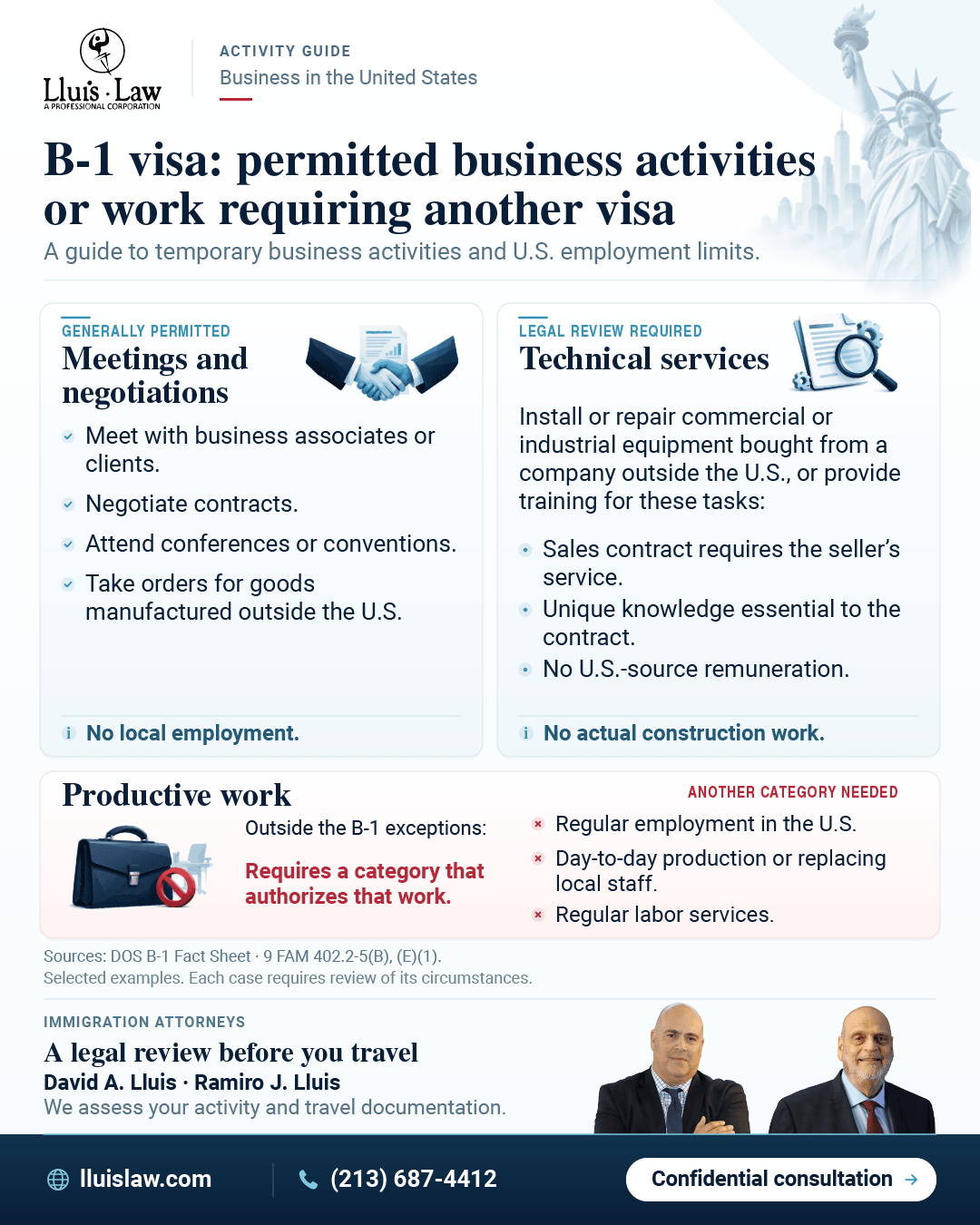
- Attend business meetings, conventions, conferences, and professional seminars.
- Consult with business associates or representatives of U.S. companies.
- Negotiate and sign contracts or conduct certain business transactions without engaging in local employment.
- Explore business opportunities, meet with suppliers, and conduct independent business research.
- Participate in certain litigation-related matters or undertake other activities expressly permitted under B-1 rules.

The Department of State outlines permitted B-1 activities. However, having a business-related reason for traveling does not mean every planned activity is authorized.
If your goal is to invest in and manage a business rather than simply meet with business associates, an E-2 visa lawyer can assess whether that category fits your nationality and business plans.
What Activities Are Not Permitted on a B-1 Visa?
Although this visa permits certain business-related activities, it does not authorize employment or compensation from a U.S. source, except under limited regulatory exceptions. It also does not replace work authorization when the actual purpose of the trip is to provide professional services in the United States.
To evaluate a business trip, we examine what the visitor will do each day, where the duties will be performed, who employs the visitor, and where the compensation comes from. What a company calls the visit does not, by itself, determine B-1 eligibility.
What If the Trip Involves Technical Services?
Hypothetical example: A foreign representative traveling to Los Angeles to negotiate the sale of machinery may engage in B-1 activities. If that person must also install or repair the equipment, the terms of the contract and the proposed duties require closer examination.
9 FAM 402.2-5 provides a narrow exception for certain services involving equipment purchased abroad. The sales contract must require the service, the visitor must possess essential specialized knowledge, and the visitor cannot receive compensation from a U.S. source. This exception does not cover construction work.
If the trip involves filling a specialty occupation position for a U.S. employer, an H-1B visa for specialty occupations or another employment-based classification may be necessary, depending on the duties and eligibility requirements.
What Are the Requirements for a B-1 Visa?
To qualify for a B-1 visa, you must meet the following requirements:
- Your trip must be for legitimate business activities;
- You must intend to remain in the United States for a limited period;
- You must have sufficient funds to cover your travel and living expenses during your stay in the United States;
- You must demonstrate that you have a residence outside the United States and ties that support your intention to return abroad after your visit; and
- You must be admissible to the United States.
One important factor is explaining why the trip will last a specific amount of time and what obligations await you outside the country. An invitation letter alone is not enough. Your travel plans and intended return must also be credible.
What Documents Do We Review for a B-1 Visa Application?
To apply for a B-1 visa to travel to the United States, you need identification documents, a clear explanation of the purpose of your visit, and evidence that the trip is temporary. The specific documentation depends on your circumstances and the consulate.
- Passport: A valid passport meeting the requirements for your nationality, including any exceptions to the general six-month validity rule.
- Form DS-160: The confirmation page and proof of fee payment, when applicable.
- Business purpose: Invitations, meeting schedules, conference programs, or correspondence about negotiations.
- Business ties: A letter from the foreign company, a description of professional duties, contractual relationships, and the source of compensation, when relevant.
- Financial resources and ties abroad: Appropriate evidence of funds, employment, business interests, residence, and other obligations outside the United States.
- Travel and immigration history: Previous passports, visas, trips, or relevant immigration decisions, if your case calls for them.
We cross-check the company letter, itinerary, and DS-160. If the invitation describes meetings but the internal plan calls for months of operational work, that inconsistency should be resolved before the interview.
What Is the B-1 Visa Application Process?
The B-1 visa application process involves Form DS-160, payment of the application fee, scheduling an appointment, and a consular interview when required. Instructions vary by consular post.
- Complete Form DS-160 online;
- Pay the applicable fee;
- Schedule an appointment at a U.S. embassy or consulate;
- Gather the required documents and attend your interview; and
- Respond to any subsequent requests for documents or administrative processing, if applicable.

Since July 15, 2026, the Department of State has indicated that nonimmigrant visa interviews should generally be scheduled in the applicant’s country of nationality or residence, with special arrangements for countries without routine consular services. Before paying a fee or booking an appointment, we check whether the proposed consular post is appropriate for the applicant’s situation.
We prepare clients to explain accurate facts that are consistent with their DS-160, rather than memorize scripted answers.
What Happens If Your B-1 Visa Is Denied?
After a B-1 visa denial, the first step is to identify the legal provision cited by the consulate. Refusals under Section 214(b) and cases involving outstanding documentation under Section 221(g) require different approaches.
- 214(b): This may mean the applicant failed to establish eligibility or overcome the presumption of immigrant intent. There is no standard consular appeal of this decision. Before reapplying, the applicant should consider whether new information or significant changes in circumstances address the reasons for refusal.
- 221(g): This may indicate missing documents or a need for administrative processing. Applicants should follow the consulate’s specific instructions.
- Other grounds: Immigration history, grounds of inadmissibility, or inconsistent statements may require a different legal analysis.
At Lluis Law, a B-1 visa lawyer would begin by reviewing the refusal notice and comparing it with the information provided on the DS-160 and during the interview. Immediately submitting the same application without addressing the identified issue may result in another expense without resolving the underlying problem. See the official explanations of visa denials.
B-1 Visa, B-2 Visa, or ESTA: Which Is Right for Your Trip?
The B-1 visa is intended for certain business activities, while the B-2 visa is used for tourism, family visits, or certain medical treatments. In many cases, consulates issue a combined B-1/B-2 visa.
If your trip is primarily for tourism, a B-2 tourist visa may be more appropriate than a B-1 visa.
If you qualify, the Visa Waiver Program (ESTA) permits certain business visits of up to 90 days without authorizing employment or guaranteeing admission. Extensions of stay and changes of status are generally not available.

Citizens of certain countries can travel to the United States for business or tourism without a visa through an ESTA application under the Visa Waiver Program. However, they may remain in the country for no more than 90 days.
Before recommending a B-1 visa, it is worth checking whether the traveler can use ESTA and whether applying for a visa through a consulate would offer any meaningful advantage.
If the goal is to engage in international trade under an applicable treaty, an E-1 visa for treaty traders may be worth exploring, depending on nationality, business activities, and other eligibility requirements. A B-1 visit is not a substitute for authorization to work in local operations.
How Long Can You Stay in the United States on a B-1 Visa?
A B-1 visitor’s authorized stay generally ranges from one to six months, depending on the period granted by the immigration officer at the port of entry. The specific expiration date appears on the I-94 record and is not determined simply by the visa’s expiration date.
In some cases, you may request an extension of up to six additional months, although the total stay in the United States generally does not exceed one year. An extension is requested from USCIS, usually on Form I-539, before the authorized period expires. Approval is not automatic.
Does a B-1 Visa Allow Multiple Entries?
The number of permitted entries depends on the visa issued and applicable reciprocity rules. Each subsequent entry is subject to inspection by U.S. Customs and Border Protection (CBP).
Frequently Asked Questions About the B-1 Visa
How Much Does It Cost to Apply for a B-1 Visa?
The base consular application fee for a business visa is $185, according to the current Department of State fee schedule. Additional fees may apply depending on nationality, applicable rules, and services obtained. Attorney fees are separate from the consular fee.
How Long Does It Take to Get a B-1 Visa Approved?
There is no universal processing timeline. Interview appointment availability varies by consulate, and additional administrative processing may be required. Avoid making nonrefundable travel commitments before receiving a decision.
Can My Family Accompany Me on a B-1 Visa?
A B-1 visa does not provide dependent visa status for family members. Each family member must independently qualify for the appropriate visa or travel authorization. For tourism, a B-2 visa or a combined B-1/B-2 visa may be suitable.
Can I Change My Status or Extend My Stay?
If you entered the United States on a B-1 visa, you may be eligible to request a change to another nonimmigrant status while in the country. You must meet USCIS requirements and check the expiration date on your I-94. Entry under ESTA generally does not permit these changes.
Do I Need an Invitation Letter From the U.S. Company?
An invitation letter can explain the meetings, dates, and participants, but it does not replace evidence of ties abroad, financial resources, and temporary intent that the consulate may consider.
Do I Have to Hire a Lawyer to Obtain a B-1 Visa?
No. You can apply on your own. A lawyer can be particularly helpful when your trip involves technical services, frequent visits, previous denials, or uncertainty about the correct immigration category.
Consult Our B-1 Visa Lawyers in Los Angeles
At Lluis Law, we can assess the purpose of your trip, identify permitted activities, organize supporting business evidence, and review potential consular obstacles. Our approach depends on the facts of your case, not a promise of approval.
Before submitting your application, it is essential to confirm that this visa is the best fit for your trip. If you or your company need a B-1 visa lawyer to prepare for a business visit, contact Lluis Law in Los Angeles to review your documents.
Latino attorneys with over 60 years of combined experience
Tell us about your case
Speak with our team about your options and next steps.
English & Spanish