


As a general rule, bringing siblings to live in the United States as lawful permanent residents is possible for U.S. citizens who are at least 21 years old.
The petition is filed by submitting Form I-130 to USCIS and places the sibling in the F4 family preference category.
This process is part of family-based immigration, although this category is subject to annual limits, which usually means a considerable wait.
At Lluis Law, our immigration attorneys in Los Angeles can review your case before filing the petition and help identify potential issues involving the family relationship, documentation, or immigration history.
LATINOS WITH OVER 60 YEARS EXPERIENCE
Tell Us Your Case
Can a U.S. citizen really petition for siblings?
A U.S. citizen can petition for a brother or sister as long as two fundamental requirements are met:
- The petitioner must be a U.S. citizen.
- The petitioner must be at least 21 years old when the family petition is filed.
This means that a permanent resident cannot file an F4 petition for a sibling, even if they have held a Green Card for many years.
This option is reserved for U.S. citizens who are at least 21 years old. The same rules apply to both brothers and sisters. These requirements are also explained in the official USCIS guidance on bringing siblings to the United States.
Note: The sibling may be inside or outside the United States. However, their location and immigration history will determine how they may complete the permanent residence process.
What immigration category applies to siblings of U.S. citizens?
Siblings fall under the fourth family preference category, known as F4. Unlike immediate relatives of U.S. citizens, only a limited number of F4 visas are available each year.
The difference is significant:
- Spouses, parents, and unmarried children under 21 of U.S. citizens are considered immediate relatives and are not subject to the same annual numerical limit.
- Siblings of U.S. citizens fall under the F4 category and must wait for a visa to become available.
- Adult or married children of U.S. citizens also fall under family preference categories with waiting lists.

U.S. immigration law establishes an annual numerical limit for the F4 category. The Department of State manages visa availability and publishes monthly updates in the Visa Bulletin.
If you would like to compare these categories, you can review our articles on:
- Bringing a spouse to the United States.
- Bringing parents to live permanently in the United States.
- Sponsoring a child over 21 as a U.S. citizen.
How can a U.S. citizen petition for a sibling to live in the United States?
The process begins with USCIS and may later continue through the Department of State or USCIS, depending on where the beneficiary is located and whether they are eligible.
Step 1: File Form I-130 with USCIS
The U.S. citizen must file Form I-130, Petition for Alien Relative, with USCIS to begin the process. Its purpose is to establish that a qualifying family relationship exists under U.S. immigration law.
In addition, the petitioner will need to submit:
- Evidence of the petitioner’s U.S. citizenship. You can learn more about these documents in “How to become a U.S. citizen.”
- Birth certificates or other documents establishing the sibling relationship.
- Additional documentation in cases involving half-siblings, step-siblings, or adopted siblings.
- The required filing fee.
USCIS requires evidence establishing the family relationship on which the petition is based. The rules may also vary depending on how that relationship was legally established.
Step 2: Obtain a priority date
The immigration priority date generally corresponds to the date USCIS receives a properly filed Form I-130 petition.
This date determines the beneficiary’s place in the waiting line for the F4 category.
Step 3: Wait for a visa to become available
Approval of Form I-130 does not mean that the foreign sibling has already received a Green Card.
Because the F4 category is subject to an annual limit, the beneficiary must wait until the priority date allows the case to move forward.
Step 4: Complete the permanent residence process
Once a visa finally becomes available, the procedure will depend on where the sibling is located:
- Outside the United States: The case will generally continue through consular processing.
- Inside the United States: It may be necessary to determine whether the sibling meets all requirements for adjustment of status.
Not everyone physically present in the U.S. can adjust status simply because their F4 priority date is current. Their manner of entry, immigration status, and any potential grounds of inadmissibility must also be reviewed.
What happens after USCIS approves a sibling’s I-130?
An approved I-130 confirms that USCIS has recognized the qualifying family relationship, but it does not yet grant permanent residence, employment authorization, or the right to live in the United States.
After approval:
- The priority date is retained.
- The case waits for an F4 visa to become available.
- Once the case can move forward, the appropriate procedure is completed.
- The beneficiary must still meet the requirements to receive an immigrant visa or adjust status.
Our guide on what happens after Form I-130 is approved explains this stage in greater detail.
How can I check the status of my sibling petition?
After Form I-130 is filed, USCIS sends a notice containing a receipt number that can be used to check the status of the case.
It is also important to monitor:
- Notices sent by USCIS.
- The priority date.
- The Visa Bulletin when applicable.
What happens if my sibling lives outside or inside the United States?
What happens if my sibling lives outside the United States?
The case will generally continue through consular processing once the beneficiary’s turn is reached.
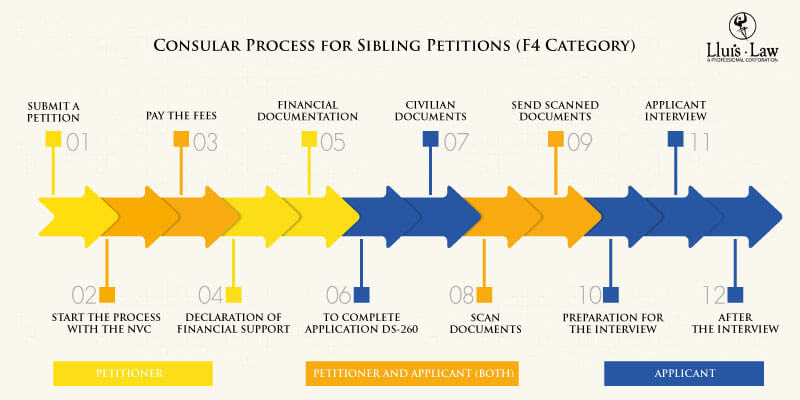
After a visa becomes available, the process may include:
- Processing through the National Visa Center.
- Payment of the required fees.
- Form DS-260.
- Affidavit of Support.
- Civil documents.
- Medical examination and required vaccinations.
- An interview at a U.S. embassy or consulate.
If everything is approved, the sibling receives an immigrant visa and may enter the United States as a lawful permanent resident.
What happens if my sibling already lives in the United States?
Being physically present in the country does not automatically mean that the sibling can complete the permanent residence process from within the United States.
Once a visa is available, it will be necessary to determine whether the sibling meets the requirements for adjustment of status.
Among other factors, it is important to review:
- How the sibling entered the United States.
- What immigration status the sibling held after entering.
- Whether the sibling accrued unlawful presence.
- Whether there is a removal order.
- Whether the sibling worked without authorization.
- Whether any ground of inadmissibility applies.
- Whether any legal exception may apply.
For this reason, an approved I-130 and a current priority date do not, by themselves, guarantee that the sibling can file Form I-485.
What documents are needed to petition for a sibling?
The required documentation depends on the type of relationship between the siblings.
Commonly required documents include:
- Form I-130.
- Proof of U.S. citizenship, such as a passport, birth certificate, certificate of naturalization, or certificate of citizenship.
- The U.S. citizen’s birth certificate.
- The sibling’s birth certificate.
- Documents showing that they share at least one parent.
- Complete English translations when required.
- Adoption, marriage, or divorce documents when necessary to establish the relationship.
- Evidence of any legal name change for the U.S. citizen or sibling, when applicable.
What if they are half-siblings, step-siblings, or adopted siblings?
These cases may qualify, but they require evidence showing how the relationship was legally established.
USCIS examines how the family relationship was legally created. Depending on the case, the following may be required:
- Birth certificates.
- Parents’ marriage certificates.
- Divorce decrees.
- Adoption documents.
- Additional evidence concerning the parent-child relationship.
In adoption cases, it may also be necessary to submit the applicable adoption decree and establish when the legal relationship was created.
For this reason, it should not be assumed that only siblings who share both parents can qualify. U.S. immigration law recognizes other family relationships when the applicable requirements are met.
Can my sibling’s spouse or children immigrate too?
Under the F4 category, the principal beneficiary’s spouse and unmarried children under 21 may qualify as derivative beneficiaries. This means:
- They do not need a separate I-130 if they qualify as derivative beneficiaries.
- They may accompany the principal beneficiary or follow to join later, as applicable.
- During a lengthy waiting period, marriages, divorces, or changes in age may affect eligibility.
For this reason, it is important to review the family’s circumstances before the visa becomes available.

How much does it cost to sponsor a sibling for a Green Card?
The first cost is the filing fee for Form I-130.
Currently, USCIS charges:
- $625: Online filing.
- $675: Paper filing.
These fees may change, so they should always be verified before submitting the form.
Depending on the procedure that follows, there may also be additional expenses.
For example, consular processing may involve:
- Immigrant visa application fee.
- Affidavit of Support review fee.
- Medical examination.
- Translations and civil documents.
- USCIS immigrant fee after the visa is issued.
Currently, the Department of State charges a $325 fee per person for immigrant visa applications based on family petitions and a $120 fee per case for reviewing the Affidavit of Support when applicable.
If the sibling is eligible for adjustment of status within the United States, the applicable forms and fees will be different.
Immigration problems and mistakes when petitioning for a sibling
What if my sibling has unlawful presence or other immigration problems?
An I-130 petition may establish the qualifying family relationship, but it does not automatically eliminate previous immigration problems.
Before moving forward with the permanent residence process, it is important to review:
- Accrued unlawful presence.
- Entries without inspection.
- Previous departures from the country.
- Deportations or removals.
- Fraud or misrepresentation.
- Criminal history.
- Other grounds of inadmissibility.
In certain cases, it may be necessary to evaluate whether one of the available immigration waivers could apply.
However, whether a waiver is available depends on the specific ground involved and whether the law permits a waiver in that situation.
Common mistakes when petitioning for a sibling
Because these petitions can remain pending for many years, it is important to start the process correctly.
Some of the most common mistakes include:
- Filing the petition as a permanent resident rather than a U.S. citizen.
- Filing before turning 21.
- Failing to properly establish the sibling relationship.
- Submitting incomplete documentation.
- Confusing approval of Form I-130 with approval of a Green Card.
- Failing to monitor the priority date.
- Ignoring communications from USCIS or the NVC.
- Assuming that being inside the United States guarantees eligibility for adjustment of status.
- Failing to report important changes of address or family circumstances.
How long does it take for a U.S. citizen to petition for a sibling?
A petition by a U.S. citizen for a sibling can take many years, primarily because siblings fall under the F4 family preference category and only a limited number of visas are available each year.
That said, the amount of time depends on several factors, including:
- The petition’s priority date.
- The beneficiary’s applicable country of chargeability.
- Visa availability in the F4 category.
- Monthly movement in the Visa Bulletin.
- USCIS and consular processing times, as applicable.
Why can the wait be so long?
It is important to distinguish between two different stages:
- Form I-130 processing: USCIS must review and decide the family petition.
- Waiting for an F4 visa: Even after Form I-130 is approved, the sibling normally must wait until the priority date allows the case to move forward.
In many cases, the wait for a visa to become available is considerably longer than the time required for USCIS to approve Form I-130.
To determine the current status of a petition, its priority date should be compared with the Department of State’s current Visa Bulletin.
Can a sibling petition be expedited?
There is no procedure that allows an applicant to bypass the wait for visa availability in the F4 category.
Although USCIS may expedite the processing of a petition in certain circumstances, this does not move the priority date forward or make a visa available when one is not yet available.
If the sibling independently qualifies for another immigration category, that alternative may have different requirements and processing times and should be evaluated separately.
Frequently asked questions about U.S. citizens petitioning for siblings
How long does a petition from a U.S. citizen for a sibling take?
It can take many years because siblings fall under the F4 category and only a limited number of visas are available. The timeline depends primarily on the priority date, the applicable country of chargeability, and future movement in the Visa Bulletin.
Which relatives can I petition for if I am a U.S. citizen?
Depending on the petitioner’s age and the applicable category, a U.S. citizen may file petitions for:
- A spouse.
- Children.
- Parents, if the U.S. citizen is at least 21 years old.
- Siblings, if the U.S. citizen is at least 21 years old.
Each family relationship is subject to different rules and processing times.
How many siblings can a U.S. citizen petition for?
U.S. immigration law does not establish a general maximum number of siblings that a U.S. citizen may petition for.
However, a separate I-130 petition must be filed for each sibling, and the applicable filing fee must be paid for each case. USA.gov confirms that each sponsored relative requires a separate Form I-130.
How much does it cost to sponsor a sibling for a Green Card?
Form I-130 currently costs $625 when filed online or $675 when filed on paper. Additional fees may later apply for the immigrant visa, NVC processing, medical examination, adjustment of status, or other procedures depending on the case.
Can a permanent resident petition for a sibling?
No. The petitioner must first become a U.S. citizen and be at least 21 years old to file an F4 petition for a sibling.
Los Angeles attorneys for sibling petitions
Petitioning for a sibling may seem straightforward when the process begins with Form I-130, but the lengthy wait associated with the F4 category makes it important to properly monitor the case throughout the entire process.
At Lluis Law, we can review:
- The family relationship and required documents.
- The filing of Form I-130.
- The priority date.
- Visa availability.
- NVC processing.
- Potential inadmissibility issues.
- Adjustment of status or consular processing when the time comes.
Our immigration attorneys in