

An I visa lawyer can determine whether your work as a journalist or foreign media professional meets the requirements for travel to the United States. From Los Angeles, we review your planned activities, media organization, and supporting documents.
If you are a journalist or member of the foreign press seeking to enter the United States for professional work, you may qualify for an I visa. However, this visa does not automatically cover every filming assignment, audiovisual project, or social media publication. The news-gathering purpose of your work is a critical factor.
Latino attorneys with over 60 years of combined experience
Tell us about your case
Speak with our team about your options and next steps.
English & Spanish
How Can an I Visa Lawyer in Los Angeles Help You?
Before preparing an application, it is important to confirm that both your assignment and the foreign media organization meet the requirements.
An attorney can review your contract, press credentials, project details, and planned activities in the United States. They can also help you prepare clear, consistent answers for your consular interview.
When evaluating an application, we first distinguish who will publish the content and for what purpose. A news assignment commissioned by a foreign media outlet raises different issues than an entertainment production or advertising campaign.
That distinction can determine whether an I visa or another immigration category is appropriate.
- Eligibility: Verify the journalistic nature of your work and the media organization’s location.
- Evidence: Organize contracts, assignments, credentials, and work samples.
- Application: Review Form DS-160 and prepare for the interview without guaranteeing approval.
- Stay in the U.S.: Evaluate extensions, employer changes, and alternatives if your project does not qualify for an I visa.
Lluis Law’s immigration lawyers in Los Angeles have more than 40 years of legal experience. We provide guidance on the consular process for your assignment.
What Is an I Visa and Who Qualifies?
The I visa is a nonimmigrant visa for representatives of foreign media, including members of the press, radio, film, and digital media who travel temporarily to the United States to perform informational or educational activities essential to their organization.
The primary requirement for an I visa is to be a bona fide representative of a media organization headquartered outside the United States. A consular officer determines whether the specific activities qualify for this visa.

Professionals who may qualify include:
- Film producers or distributors: If you produce or distribute films for educational or informational purposes, you may qualify when the primary financing and distribution are foreign.
- Journalists under contract: Journalists with contracts to gather news for a media company based in another country.
- Photographers, editors, and film crews: Professionals whose work is essential to news reports or informational documentaries.
- Journalists or employees of independent production companies: They may qualify if they work on a documentary or film a newsworthy event and have the required supporting evidence.
- Tourism bureau representatives: They may qualify when providing tourism information and meeting the special requirements for offices associated with a foreign government.
- Foreign journalists covering U.S. events: International journalists may apply when traveling to the United States to report on an American event for an audience abroad.
Digital content creators do not qualify simply because they post videos. Authorities consider whether the work is journalistic, which organization the applicant represents, and the actual purpose of the trip. The State Department’s official guidance on visas for foreign media representatives explains which activities may qualify.
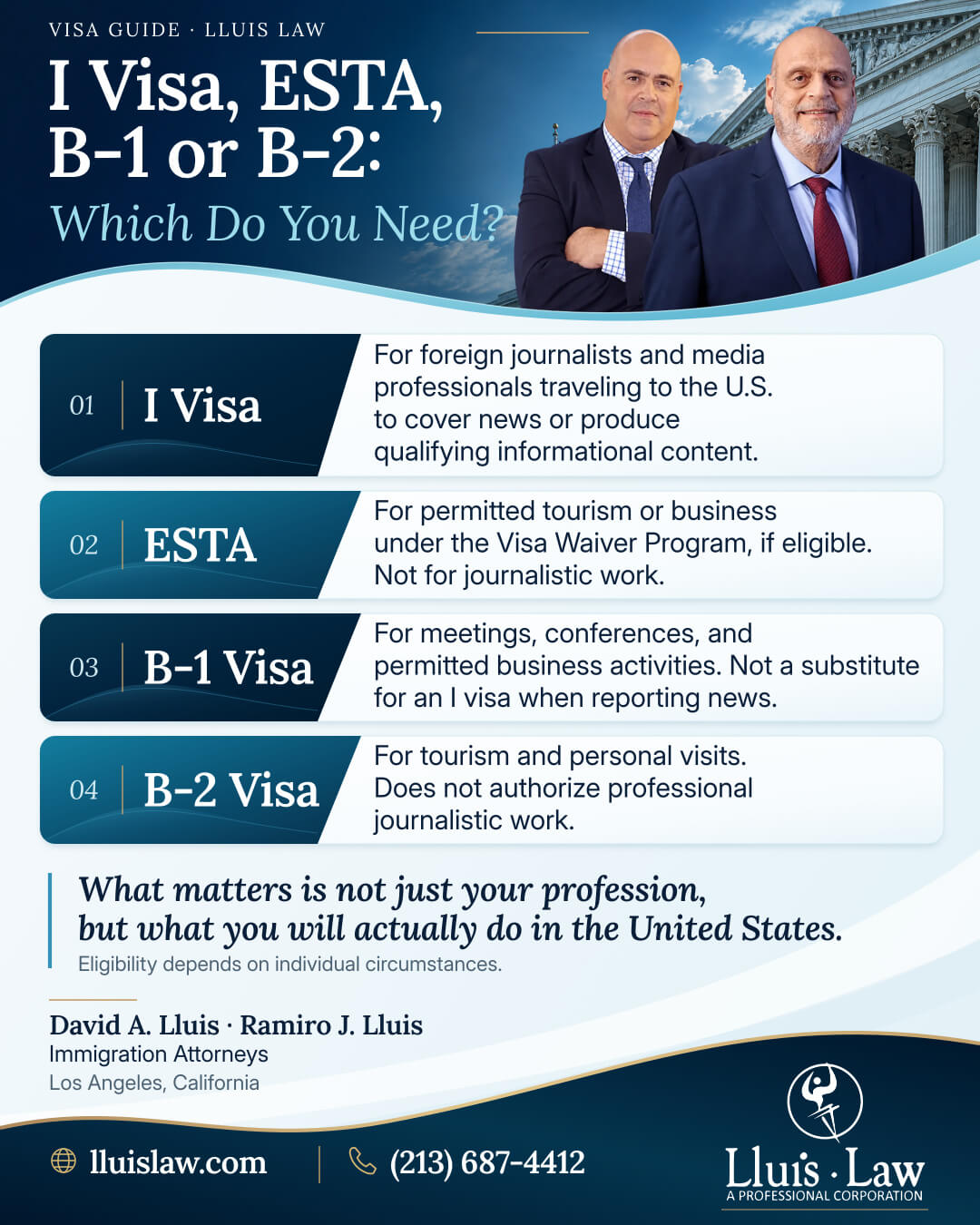
When Do You Need an I Visa Instead of ESTA or a B Visa?
Foreign nationals eligible for the Visa Waiver Program who plan to travel to the United States as media representatives to gather news generally need an I visa, even if they qualify to travel with an ESTA travel authorization.
If your trip involves attending meetings or conferences without covering them as a journalist, a B-1 visa lawyer can assess whether the business visitor category is appropriate. You may not need an I visa for activities such as:
- Attending a conference, seminar, or meeting without reporting on it during the trip or after returning home.
- Taking still photographs without receiving income from U.S. sources, provided the activity is not journalistic coverage requiring an I visa.
- Conducting independent research or certain academic activities permitted for visitors.
- Visiting the United States for tourism without working or reporting on the trip.
For vacations and other strictly personal visits, a B-2 visa may be appropriate. A B-2 visa lawyer can explain this alternative.
Commercial, advertising, or entertainment productions may require another category, such as an O-1 visa for individuals with extraordinary ability, if the applicable requirements are met.
For artistic or performance projects, consulting a P visa attorney for performers may also be useful. No visa category is granted based solely on a job title.
How Do We Distinguish News Coverage From Entertainment?
During a legal review, the project’s title alone is not enough. We examine the script or editorial description, who finances the production, the intended audience, and the duties of each crew member.
If the documents describe an entertainment project while Form DS-160 identifies the purpose as journalism, that inconsistency should be addressed before the interview.
How to Apply for an I Visa for Journalists
An I visa lawyer can determine whether your contract, assignment letter, and credentials support your application before you schedule an interview.
The I visa application process is similar to that of other nonimmigrant visas. Generally, you will complete the following steps through a U.S. embassy or consulate. When applying from abroad, this category does not require a prior employer petition filed with USCIS.
- Confirm your eligibility: Verify the informational nature of your assignment and the foreign headquarters of your media organization.
- Complete Form DS-160: Use the official DS-160 application and save your confirmation page.
- Pay the consular fee: Follow the payment instructions provided by the embassy or consulate where you will apply.
- Prepare for the interview: Gather documents establishing your role and the nature of your project.
- Attend the interview: A consular officer will assess your circumstances and eligibility and may request additional evidence.

What Documents Do I Need to Apply for an I Visa?
Before attending your I visa interview, you will need to gather these basic documents:
- A valid passport that remains valid for at least six months beyond your intended stay, unless an exception applies under country-specific agreements.
- Your Form DS-160 confirmation page.
- A fee payment receipt, when applicable.
- A photograph meeting consular requirements if you were unable to upload one successfully with Form DS-160.
I visa applicants may also need to provide additional documents at the U.S. embassy or consulate. These typically include:
- A letter from your employer explaining the purpose of your visit, the length of your employment contract, or the compensation you will receive.
- A current contract, particularly if you are a freelance journalist. The media organization’s letter should describe your employment arrangement and establish that you represent the organization.
- Licenses, press credentials, or other qualifications showing that you are a journalist or media professional, when applicable.
- A reporting itinerary, documentary description, or evidence of the informational nature of the content.
A medical certificate or police clearance certificate is not generally required from every I visa applicant as part of this basic document list. The consular post may request additional documentation based on individual circumstances.
As of October 1, 2026, I visa applicants are subject to expanded online presence screening. The Department of State instructs applicants to set their social media profiles to public or open for the vetting process. See the official announcement about this measure.
How Much Does an I Visa Cost?
The consular application fee for an I visa is $185, according to the State Department’s official visa fee schedule. This is a nonrefundable processing fee.
Depending on your nationality, an additional visa issuance fee based on reciprocity may apply. Attorney fees, if you hire legal representation, are separate from government charges. Check the current fees before making a payment.
How Long Is an I Visa Valid, and How Can You Extend Your Stay?
The validity of the visa in your passport and your authorized period of stay in the United States are different. Visa validity depends in part on reciprocity rules for your country of nationality. Your authorized period of stay is shown on the Form I-94 issued upon admission.
In general, foreign media representatives in I status may be admitted for duration of status (D/S), tied to their work for the same foreign media organization.
- General rule: Form I-94 may show D/S as long as the conditions of the authorized stay continue to be met.
- Exception for certain Chinese passport holders: I nonimmigrants from China may be admitted for a maximum of 90 days unless they hold a passport issued by the Hong Kong or Macau Special Administrative Region.
Important: A rule issued in July 2026 sought to limit admission for most I visa holders to 240 days. A federal court blocked its implementation on September 14, 2026. That limit does not apply while the court order remains in effect. Check the latest status of the litigation before planning your stay or an extension.
When Do I Need to File Form I-539?
If your Form I-94 lists a specific expiration date and you need to remain in the United States longer, you may need to request an extension using Form I-539 before your authorized stay expires. USCIS authorization may also be required to change employers or the type of news media organization you work for.
You must also provide evidence of your current status and a letter from the foreign media organization you work for. Your admission date, immigration classification, and documents supporting the new project should be reviewed before you take action.
What Does an Attorney Review Before a Change in Activities?
At Lluis Law, when reviewing an extension, we distinguish between a new assignment for the same media organization, a change of employer, and an admission with a specific expiration date. These situations do not necessarily involve the same process. If your project changes while you are in the United States, it is important to review your I-94 and immigration classification history first.
Can Your Family Accompany You to the United States on an I Visa?
Spouses and unmarried children under age 21 who wish to accompany an I visa holder may also be eligible for visas in the same I classification. Couples must be legally married to qualify.
To establish the family relationship, applicants generally need:
- Spouse: A marriage certificate and, when applicable, evidence that any previous marriages were legally terminated.
- Children: Birth certificates establishing the family relationship.
- Each applicant: Their own Form DS-160 and any other required consular documents.
Family members admitted in this classification may study in the United States, but they are not authorized to work solely because they hold an I visa. If they need employment authorization, another immigration basis must be considered.
They do not necessarily need an F-1 or M-1 student visa to study.
What If Your Family Members Only Want to Visit?
If your spouse or children do not intend to stay in the United States with the principal I visa holder but only want to visit, they may qualify for a B-2 visa, depending on their circumstances.
Frequently Asked Questions About I Visas for Journalists
Here are answers to common questions about processing times, freelance work, and permanent residence.

How Long Does I Visa Processing Take?
There is no universal approval timeline. Processing time depends on appointment availability, the consulate, the interview, and any administrative processing. Check the wait times at the location where you will apply before setting a travel date.
Can Freelance Journalists Get an I Visa?
Yes. Freelance journalists may qualify if they meet the requirements and, when applicable, can document a valid contract with a foreign media organization.
The key is to establish that the work in the United States is journalistic and connected to that organization, rather than simply submitting a personal portfolio. An I visa lawyer can review the assignment and evidence of the professional relationship before the application is submitted.
Can I Get a Green Card With an I Visa?
An I visa does not, by itself, provide a path to a Green Card. However, some holders may be able to change their status or qualify for an independent pathway to permanent residence.
You should discuss how that process could affect your current status and travel plans with a green card lawyer.
How Can Lluis Law Help With Your I Visa?
At Lluis Law, our attorneys can help you navigate the I visa application process for foreign media professionals. We can assess whether your journalistic assignment meets the requirements, identify missing documentation, and guide you through the consular process before you travel.
Contact us today for personalized legal guidance tailored to your situation.
Latino attorneys with over 60 years of combined experience
Tell us about your case
Speak with our team about your options and next steps.
English & Spanish