


If you need to connect through the United States on your way to another country, you may need a C-1 transit visa. This classification allows immediate and continuous transit. It does not authorize sightseeing, employment, or family visits during a layover. A C transit visa lawyer can assess whether this is the right option for your trip.
Some foreign nationals do not need this visa. For example, travelers with a B-1 visa or an ESTA authorization may be able to use those options if they meet the applicable requirements. A C transit visa lawyer can identify the appropriate option before you begin a consular application.
Latino attorneys with over 60 years of combined experience
Tell us about your case
Speak with our team about your options and next steps.
English & Spanish
When Do You Need a C Transit Visa Lawyer for the United States?
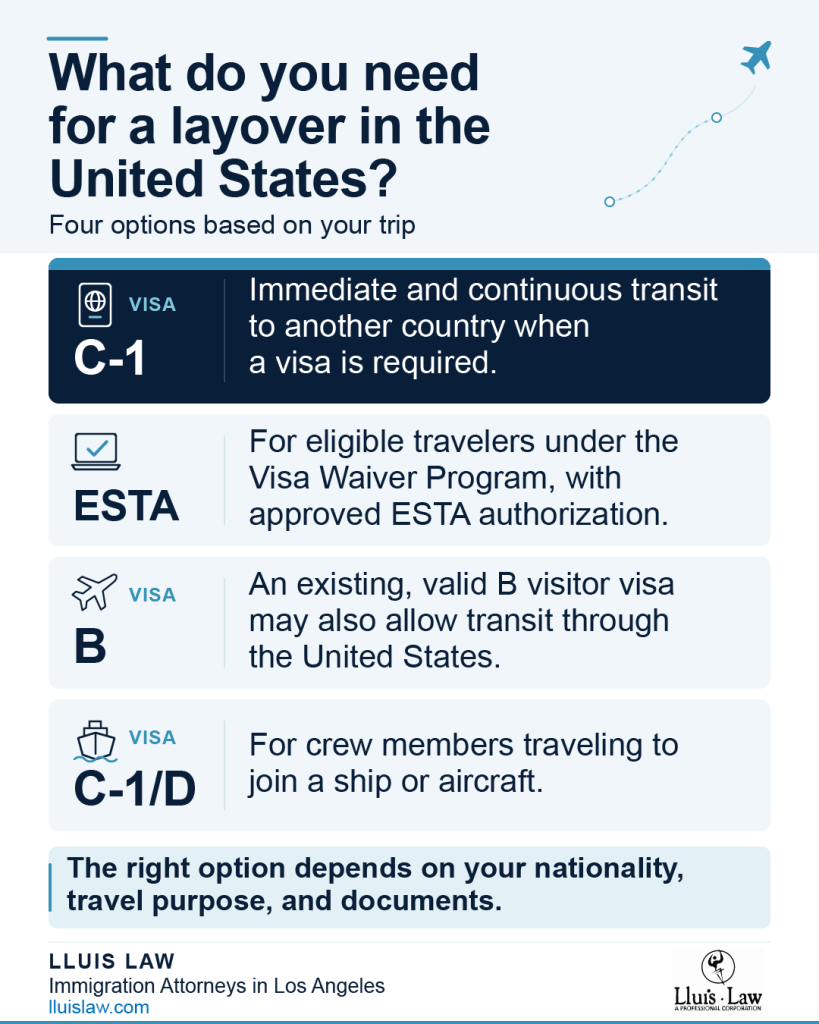
Legal assistance can be particularly helpful when it is unclear whether the appropriate classification is C-1, a visitor visa, ESTA, or C-1/D. You should also have your case reviewed before reapplying after a visa denial or if you have a history of inadmissibility or immigration violations.
At Lluis Law in Los Angeles, California, we do not start with Form DS-160. We first determine the purpose of the layover and review the documents supporting it. An immediate flight connection requires a different assessment from a personal visit or a crew member joining a vessel.
- Transit-only layover: A C-1 visa may be appropriate when no other valid option is available.
- Traveler eligible for ESTA: You may be able to transit using ESTA if you meet all the requirements.
- Valid B visa or planned visit: You should determine whether you can use your existing B visa or need a B-2 tourist visa.
- Travel to join a crew: A combined C-1/D visa may be appropriate, and proof of your position on board may be required. See our guide to working with a D visa lawyer for crew members.
The Department of State’s official transit visa guidance recognizes alternatives to a C visa and requires the purpose of entry to be consistent with transit.
How Do You Apply for a C-1 Transit Visa for the United States?
To apply for a C-1 visa, you must first confirm your eligibility, submit Form DS-160, pay the applicable fee, and follow the instructions of the consulate handling your application. An interview is generally required, and the consular officer makes the decision.
- Determine whether a C-1 is the appropriate type of U.S. visa. Confirm that you will be traveling to another country through immediate and continuous transit.
- Complete Form DS-160 online. Check that your passport information and itinerary are consistent.
- Pay the applicable application fee and keep your receipt if the consulate requires it.
- Schedule your appointment according to the instructions of the consular post in your country of nationality or residence, unless an exception applies.
- Gather all required documents and supporting evidence, including your passport, DS-160 confirmation, proof of your final destination and transit arrangements, and evidence of available funds.
- Attend your interview. Explain consistently why you need to travel through the United States and how you will continue your journey.
Since July 15, 2026, the Department of State has generally required nonimmigrant visa applicants to schedule interviews in their country of nationality or residence. The policy provides exceptions, including for C-2 and C-3 visas, but no general exception for C-1 visas.
Before paying or selecting a consulate, review the current visa interview scheduling instructions and conditions at the relevant consular post.
What Types of C Visas Are Available in the United States?
There are three main C visa classifications, depending on the purpose of transit. The C-1 is generally used for layovers on the way to another country.

- C-1 visa: For foreign nationals making a brief stop in the United States while traveling to another country. It is the most common transit visa.
- C-2 visa: For travelers transiting through the United States to or from the United Nations Headquarters District under the terms of the UN Headquarters Agreement. Transit is restricted to the authorized area of New York.
- C-3 visa: For foreign government officials and eligible accompanying individuals transiting through the United States on official government business.
If you are a foreign government official or diplomat, another classification may apply, including an A diplomatic visa for government officials, depending on your duties. The combined C-1/D is not a fourth general category. It incorporates crew member classification when appropriate.
Who Is Eligible for a C-1 Transit Visa to the United States?
A person who needs to pass through the United States solely to reach another country and can demonstrate that the journey will be immediate and continuous may apply for a C-1 visa. Eligibility is not established simply by holding a ticket with a connection.
- Travelers making a brief stop in the United States to connect to another country.
- Cruise ship passengers and passengers on other vessels making a temporary stop in the United States without intending to disembark.
- Crew members traveling as passengers to join a ship or aircraft, who may also need a D visa or combined C-1/D visa.
- Foreign nationals who can provide evidence of onward transportation, available funds, and permission to enter their destination country when required.
At Lluis Law, we focus on three pieces of evidence before evaluating a strategy: whether the ticket confirms departure for a third country, whether the traveler can be admitted there, and whether the explanation for the transit matches Form DS-160. A connecting flight reservation alone does not resolve a lack of permission to enter the final destination.
Who Should Not Apply for a C-1 Visa?
A C-1 visa is not appropriate if the main purpose of your stop is to visit family, go sightseeing, engage in business activities, or remain in the United States longer than necessary to continue your trip.
- Travelers planning sightseeing or personal visits during a layover should consider a U.S. tourist visa.
- Travelers intending to work in the United States are not authorized to do so merely because they hold a C-1 visa.
- Crew members should confirm whether their activities require a D, C-1/D, or another classification. Not every work-related trip by sea or air qualifies as C-1 transit.
A C-1 visa does not, by itself, authorize activities other than transit or allow you to change or extend your transit status. If your stated purpose does not match your actual travel plans, you should select the proper classification before applying.
What Documents Do You Need to Apply for a C-1 Transit Visa?
Basic documentation includes a passport, DS-160 confirmation page, and required consular receipts. The officer may also request evidence of your international connection, available funds, and authorization to enter your destination country.

- Passport: Valid for travel to the United States and, generally, valid for at least six months beyond the intended stay, unless an applicable agreement provides an exemption.
- Form DS-160: Printed confirmation page with the barcode.
- Photograph: Uploaded during the DS-160 application. If the upload fails, a printed photograph meeting official specifications may be required.
- Fee and appointment: Payment receipt, if payment is required before the interview, and appointment confirmation according to local instructions.
Additional Evidence That May Determine the Outcome
- Itinerary: Reservations or other evidence of transportation to a third country, along with an explanation of any extended layover.
- Final destination: A visa or other permission to enter the next country, or proof that no such authorization is required.
- Financial resources and ties: Evidence that you can pay for your transit and documentation of your residence or intention to continue traveling, if requested.
- Special circumstances: A letter from an employer or agent identifying the ship or aircraft you will join if you are traveling as a crew member. You may also be asked for documents explaining any prior deportation, removal, or denial of entry to the United States.
This is why we review whether the documents tell a consistent story, not merely whether an applicant has completed a checklist. Hypothetical example: A person states on Form DS-160 that they will travel directly to a third country, but their reservation includes a two-day stop to visit acquaintances. Before presenting the trip as C-1 transit, the actual purpose should be clarified and a visitor visa considered if the traveler intends to make that visit.
The 9 FAM 402.4 guidance on transit visas requires, among other things, onward transportation, sufficient funds, and permission to enter the next country when necessary.
How Much Does a C-1 Transit Visa Cost, and How Long Does Processing Take?
The official visa fee schedule lists a $185 application fee for a C-1 visa. Verify the amount before paying. Additional issuance fees or other applicable charges may apply under current rules.
There is no universal three-to-five-day processing time for a C-1 visa. You must distinguish between the wait for an interview, consular review, any additional administrative processing, and passport return.
- Appointment: Availability varies by embassy or consulate. Check the official wait times for crew and transit visas.
- Decision: Timing depends on the individual case, the information submitted, and any required checks.
- Administrative processing: This can extend the process for an indefinite period and is not included in certain wait-time estimates.
Our approach is to review these timeframes before recommending a travel date. Even with a properly planned itinerary, appointment availability or administrative review may prevent a visa from arriving in time. Do not buy tickets yet: Wait until you have your visa before making final travel arrangements.
How Long Can You Stay in the United States on a C-1 Transit Visa?
Admission in C-1 status is limited to the time necessary for immediate and continuous transit, subject to a regulatory maximum of 29 days. This does not mean you are entitled to remain for 29 days if your connection requires you to leave sooner.
This classification is not intended for additional activities. The validity period printed on the visa and the length of stay authorized by CBP are different matters.
Under the official rules on visa validity and admission, CBP determines whether to admit you and for how long. C-1 transit status does not permit an ordinary extension of stay or change of classification.
What Should You Do if Your C-1 Transit Visa Was Denied?
First, identify the reason for the refusal. A denial under Section 214(b), which relates to failure to establish eligibility for the visa, is different from a refusal under Section 221(g) involving missing information or administrative processing.
- 214(b): Reapplying generally requires showing that you meet the requirements and, where possible, significant changes since the previous assessment. Resubmitting the same application without addressing its weakness may not help.
- 221(g): If the consulate requests documents, follow its instructions. If administrative processing is required, wait for notification of the outcome.
- Other grounds: If you have prior immigration issues, inaccurate statements, or other possible grounds of inadmissibility, the precise legal basis should be evaluated before you reapply.
At Lluis Law, we review the stated reason for a refusal before preparing a response. Missing proof of permission to enter the final destination calls for a different documentary solution than doubts about the real purpose of the trip or a prior ground of inadmissibility.
The Department of State explains refusals under Sections 214(b) and 221(g) and the steps that may apply. Reapplying does not result in automatic approval.
Frequently Asked Questions About C-1 Transit Visas for the United States
These answers address common questions about layovers, crew member visas, and the consequences of admission in C-1 status.

Do I Need a Visa to Transit Through the United States if I Stay at the Airport?
You may need one even if you are only changing planes and remain at the airport. The United States does not have a general visa-free transit program. Travelers must hold an appropriate visa or qualify for an exemption, such as the Visa Waiver Program with a valid ESTA authorization.
Not every traveler needs a C-1. For example, a valid B visa may be used for transit, and certain Canadian citizens are visa-exempt in common circumstances. Check your individual situation and CBP’s guidance for travelers transiting with ESTA.
What Is the Difference Between a C-1 Visa and a D Visa?
A C-1 visa permits transit through the United States, while a D visa is intended for crew members working aboard ships or aircraft. If a worker enters as a passenger to join a crew, both classifications may be required, and a combined C-1/D visa may be issued.
In these cases, we verify that the employer’s letter, itinerary, and boarding date are consistent. A tourist’s layover and a crew member joining a ship should not be documented in the same way.
Can I Leave the Airport or Visit Family With a C-1 Visa?
A C-1 visa permits necessary transit, not recreational visits. Although transit may involve passing through immigration inspection and traveling onward, you cannot turn the layover into a vacation or family visit. If that is your plan, assess the appropriate visitor classification before traveling.
If your question concerns a domestic flight, see our guide to traveling within the United States without legal status. That is a different situation from international transit on a C-1 visa.
Does Every Member of My Family Need a Separate C-1 Visa?
Yes. Every traveler who requires a visa must submit an individual application and meet the admission requirements, including minors. There is no derivative C-1 visa that replaces an individual application.
Can Someone Admitted on a C-1 Visa Apply for Adjustment of Status?
There is no one-size-fits-all answer. Admission as a crew member can trigger significant restrictions on adjustment of status. In other C-1 transit cases, the analysis depends on how the person was admitted, the immigration category, the basis for the petition, and any applicable statutory exceptions. A C-1 visa is not intended as a pathway to living permanently in the United States.
If you entered with a C-1 and your personal circumstances later changed, you should obtain your admission record and determine whether you traveled to join a crew before deciding whether you can apply for permanent residence.
C Transit Visa Lawyer in Los Angeles: How We Can Help
Lluis Law provides immigration counsel from Los Angeles, California. If you need a C-1 visa, our team can review your route, confirm the appropriate classification, and help you organize your application, supporting travel documents, and interview preparation.
Our immigration lawyers in Los Angeles can examine complicated connections, crew member travel, previous visas, and consular denials. Our goal is to present an accurate, consistent explanation of your trip without promising an outcome that rests with U.S. authorities.
Latino attorneys with over 60 years of combined experience
Tell us about your case
Speak with our team about your options and next steps.
English & Spanish