

If you work on a cruise ship, commercial vessel, or international airline, a D visa lawyer can help you determine whether you need a D visa or a C-1/D visa to enter the United States temporarily.
At Lluis Law in Los Angeles, we review your onboard position, travel and boarding itinerary, and employment documentation. The key distinction is whether you arrive as a crew member or as a passenger traveling to join a vessel or aircraft.
Latino attorneys with over 60 years of combined experience
Tell us about your case
Speak with our team about your options and next steps.
English & Spanish
When should you consult a D visa lawyer for crew members?
You should consider legal advice if you will join a crew in the United States, transfer to another vessel, have had a visa refusal, or are unsure which visa category applies. Lluis Law’s immigration lawyers in Los Angeles can review these factors before you complete Form DS-160.
Our review begins with three details that can affect your visa category or required documentation:
- Your actual position and duties on board.
- Your route of entry, boarding, and departure.
- Your employer’s letter and whether it matches Form DS-160.
A job offer does not always establish that you will transit to join a crew. If your DS-160 identifies one route or port while your employment letter lists another, you should resolve the discrepancy before your interview.
At Lluis Law, we compare your itinerary, duties, and transportation arrangements. If the information conflicts, we recommend requesting a corrected letter from the shipping company or airline rather than submitting additional documents that fail to resolve the issue.
What is a crew member visa?
A D visa is a temporary visa for individuals who perform essential services aboard commercial vessels or international aircraft. It allows temporary entry to carry out those duties, subject to departure requirements. It is one of the nonimmigrant types of U.S. visas.
Eligible workers may include pilots, flight attendants, captains, and sailors, as well as cooks, medical personnel, and other essential onboard staff.

Who can apply for a D visa?
The D visa is intended for crew members who perform duties such as:
- Pilot or flight attendant on a commercial aircraft.
- Captain, sailor, or engineer aboard a ship.
- Trainee aboard a training vessel.
- Lifeguard, cook, hairstylist, server, or other onboard service worker.
You may apply for the visa even if you do not yet have a job. However, to use it for entry, you must be working as a crew member aboard the relevant vessel or aircraft.
For most crew members, departure must take place within 29 days, either on the same vessel or on another one. A special D-3 classification applies to certain transfers of liquid cargo between vessels, with a limit of up to 180 days. It is not the standard D visa.
Can a contractor qualify for a D visa?
At Lluis Law, we do not rely solely on the job title in a contract. We examine the actual duties, manifest information, and whether the work is necessary for normal operations on board. Even a contractor may qualify.
If you are listed as a passenger or are entering to repair a vessel while it is in port, the same employment letter may point to a different visa category. This distinction should be resolved before applying.
Which jobs do not qualify for a D crew member visa?
Some maritime jobs require a different visa classification. Official examples include:
- Dry dock: warranty repairs while a ship is docked may fall under a B-1 visa for business activities, depending on the specific work involved.
- Coasting officer: certain crew changes involving officers aboard foreign vessels may fall under the B-1 category.
- Yachts: crews of recreational yachts generally fall under B-1; a D visa may apply to a commercially operated yacht, depending on the duties and other requirements.
- Fishing vessels: certain crew members aboard vessels with a U.S. home port or U.S.-based operations may need an H-2B visa for temporary workers or another H-2 classification.
- Outer Continental Shelf: certain services may require a B-1 visa or another category, depending on the activity.
These are not automatic changes in visa classification. The appropriate category depends on the vessel, work location, employer, and intended duration.
Restrictions on a crew member visa
A D visa does not authorize you to accept other jobs on land, live permanently in the United States, or remain beyond your authorized period of stay. As a general rule, crew member status also does not allow you to extend your stay or change to another status while in the country.
Crew member status can also prevent adjustment of status in the United States, even if a family-based or employment-based immigration option later becomes available. Certain legal exceptions require an individual assessment. You should not assume that a C-1/D visa can be converted into permanent residence.
Does sailing into international waters count as departing the United States?
For departure requirements, the actual route matters. Sailing into international waters and returning without stopping at a foreign port may not be enough. The consular guidance on D visas distinguishes this situation. That is why we verify the itinerary after the vessel sets sail, not just its departure date.
What is the difference between a D visa and a C-1/D visa?
The D visa covers work as a crew member. The C-1 transit visa covers immediate transit to the location where you will join a vessel or aircraft. If you arrive as a passenger to join a crew, you generally need both classifications. A consulate may issue a combined C-1/D visa when reciprocity permits.
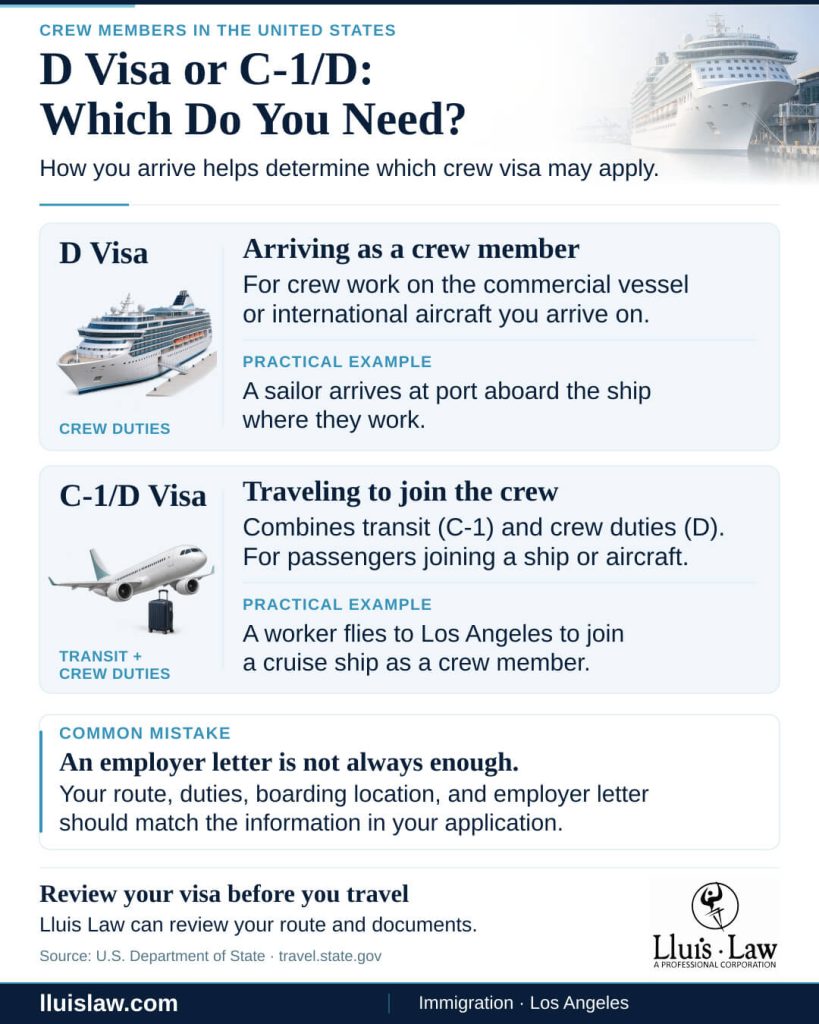
- Already arriving as a crew member: a D visa may be the appropriate classification for the port call.
- Flying in to join a cruise ship: you generally need both C-1 and D, often issued together as a C-1/D visa.
- Joining a vessel for a cargo transfer: a special C-4/D-3 classification may apply if you meet its requirements.
Hypothetical example: a worker arrives in Los Angeles to join a cruise ship. The documents must explain the transfer to the port. If that same person instead arrives aboard the ship and continues on its international route, a different visa classification may apply.
A C-1/D visa does not allow you to use transit for independent sightseeing trips or to work for another company on land. Activities incidental to a port call must comply with the conditions of admission.
What do D-1 and D-2 mean on immigration documents?
D-1 and D-2 may appear as crew member classification or admission codes related to departing on the same vessel or a different one. However, the consular guidance identifies issued visas as D or C-1/D. They are not two separate consular visas that you must apply for individually.
How do you apply for a D crew member visa?
You apply through a U.S. embassy or consulate. The process includes Form DS-160, the required documents, and generally an interview. A D visa lawyer can help you check that your evidence is consistent before you apply.
Documents required for a D or C-1/D visa
To apply for a D crew member visa for the United States, you must provide the following documents:
- A valid passport. As a general rule, it must remain valid for at least six months beyond your intended stay, unless an exception applies under a country-specific agreement.
- A recent photograph that meets consular specifications, especially if the digital upload fails.
- The confirmation page for your electronic Form DS-160 application.
- A payment receipt, if the consulate requires payment before the interview.
- An employment letter specifying your position as a crew member.
The consulate may also request evidence of the purpose of your trip, your intent to depart the United States, and how your expenses will be covered. If you are joining a ship, your employer’s or agent’s letter should explain the following, as applicable:
- The vessel’s or airline’s name and the position you will hold.
- The port or airport where you will join the crew and your expected entry and departure dates.
- Your route or itinerary, the reason for your transfer, and the employer’s or agent’s contact information.
- Who will cover transportation, lodging, and other expenses during transit.
An employment letter does not replace mandatory documents or guarantee approval. At Lluis Law, we check names, dates, job titles, and ports for consistency across your passport, DS-160, and employer documentation.
If your vessel or port changes after you apply, we assess which details should be updated or explained to the consulate.
Steps to prepare your consular application
- Determine the correct visa category: D, C-1/D, or an alternative if your work does not qualify as crew member duties.
- Complete Form DS-160: accurately describe your purpose of travel, employer, and route.
- Pay the fee and schedule an appointment: follow the instructions from the consulate where you will apply.
- Prepare for the interview: bring the required documents and any supporting employment evidence that may be requested.
- Await the decision: if additional documentation or administrative processing is required, follow the consular post’s instructions.
Since July 2026, the general rule has been to schedule your visa interview in your country of nationality or residence. Exceptions and designated posts exist. Applying in a third country may complicate the review or lengthen the wait. Check the current consular instructions before booking.
In-person interviews are generally required for D and C-1/D visas. Since October 2025, D visa renewals have not qualified for a standard interview waiver. The former general age-based exemptions no longer apply.
How much does a D visa cost, and how long does it take?
The consular application fee for a D or C-1/D visa is $185 and is nonrefundable. Depending on your nationality, an additional visa issuance fee may apply. Check the official visa fee schedule before paying.
There is no universal processing time. Appointment availability varies by consulate, and some applications require administrative processing. Before setting a boarding date, gather your employment evidence and check available appointments. Avoid paying for nonrefundable travel until your visa has been issued.
Frequently asked questions about D crew member visas
What is a C-1/D visa?
A C-1/D visa combines transit and crew member classifications. For example, it may be used by someone arriving as a passenger to join a cruise ship. It does not authorize work on land for another company or activities unrelated to the approved purpose of travel.
Can my C-1/D visa application be denied?
Yes. A C-1/D visa application may be refused if the applicant fails to establish eligibility or is subject to an immigration-related bar.
Not all visa refusals mean the same thing:
- 214(b): the consular officer determines that the applicant has not established eligibility for the nonimmigrant visa.
- 221(g): additional documents or administrative processing may be required before a final decision can be made.
Before reapplying, we review the legal basis for the refusal, which evidence was missing, and whether your circumstances have changed. Submitting the same application again without addressing those issues may not help. In certain cases, we also assess whether any waiver of inadmissibility may be available.
What type of visa do flight crew members need?
Pilots and flight attendants working for international airlines may need a D visa to perform their crew duties. If they arrive as passengers to join an aircraft, a C-1/D visa may be appropriate. The correct classification depends on their itinerary and duties.

How long is a crew member visa valid?
Not all D visas are valid for two years. Visa validity and the number of permitted entries depend on your nationality and the applicable reciprocity rules. Visa validity is also different from the length of stay authorized on each entry. The general 29-day limit applies to most crew members.
Can family members apply for a crew member visa?
No. Family members do not receive D visas simply because they accompany a crew member. If they travel to the United States to visit, without working on board, they may need a B-2 tourist visa or another travel authorization appropriate for their purpose of travel.
The Visa Waiver Program and ESTA are alternatives only for people who meet their requirements. Neither authorizes employment as a crew member.
Do I need a lawyer to apply for a D crew member visa?
You are not required to hire a lawyer to apply for a D visa. You may submit the application yourself. A D visa lawyer can be helpful if you are unsure which category applies, are missing documents, or have had previous immigration issues.
At Lluis Law, we review your contract and intended route, vessel changes, prior stays, and any visa refusals. This information helps us identify evidence that needs clarification before you submit a new application. The consulate always makes the visa decision.
How can Lluis Law help you?
Attorneys Ramiro J. Lluis and David A. Lluis have more than 60 years of combined legal experience in immigration, criminal, and civil matters. For D and C-1/D visa applications, we draw on that experience to evaluate onboard duties, travel routes, and potential immigration obstacles.
Our approach focuses on the details that may influence the consular decision, not the number of documents submitted:
- Your contract and the duties you actually perform on board.
- Whether you arrive as a passenger or crew member and need a C-1/D visa.
- Changes to vessels, dates, and employer documentation.
- Previous refusals, unmet eligibility requirements, and potential grounds of inadmissibility.
If you need a D visa lawyer for your onboard position, guidance about a C-1/D visa, or assistance after a refusal, contact Lluis Law to discuss your case. From Los Angeles, we can guide you through the documentation and consular process. Approval rests with U.S. authorities.
Latino attorneys with over 60 years of combined experience
Tell us about your case
Speak with our team about your options and next steps.
English & Spanish